
The Joint CSIR–UGC NET is the exam that decides three things at once: whether you get a funded research fellowship, whether you are eligible to be appointed as an Assistant Professor, and whether you can be admitted to a PhD. One paper, three outcomes — and most candidates do not realise until after the result that those are separate results rather than degrees of the same one.
This is the general guide to the exam: the five subjects, how the paper is built, how it is marked, who may sit it, and what each grade of result actually gives you. Subject-by-subject syllabus and strategy are separate articles.
1. What the exam is for
CSIR NET is conducted by the NTA on behalf of the Council of Scientific and Industrial Research, twice a year, for candidates in the natural sciences. It is not an admission test to a particular institute. It is a national eligibility certificate: you qualify, and that qualification is then used by universities, laboratories and colleges across the country.
It covers five subjects, and you sit exactly one of them.
| Subject | Broadly covers |
| Chemical Sciences | Physical, organic, inorganic and analytical chemistry |
| Earth Sciences | Atmospheric, ocean, planetary and earth sciences |
| Life Sciences | Molecular biology, cell biology, genetics, ecology, physiology |
| Mathematical Sciences | Analysis, algebra, differential equations, statistics, numerical analysis |
| Physical Sciences | Classical and quantum mechanics, electromagnetism, thermodynamics, electronics |
2. How the paper is built
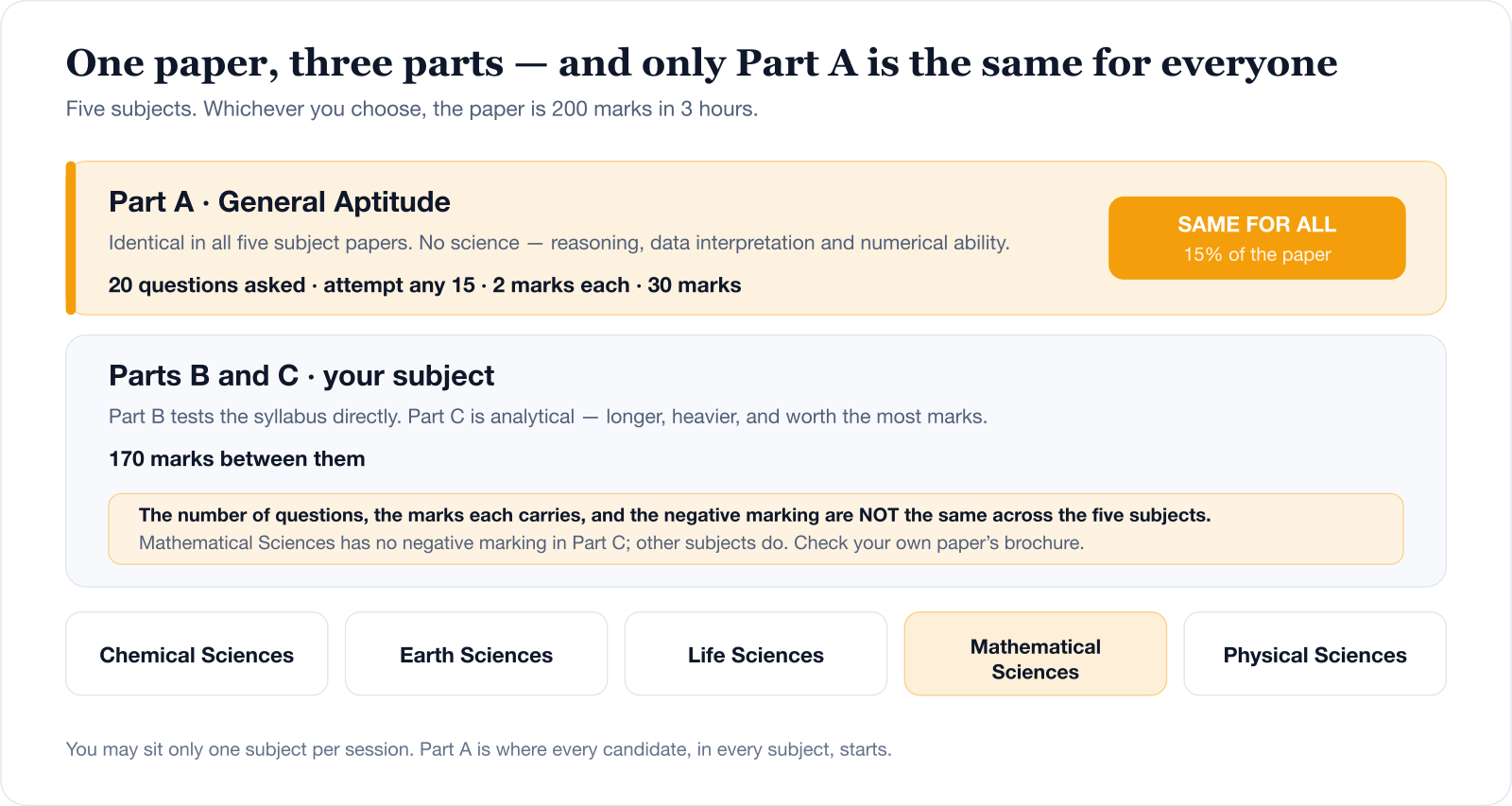
Every paper is 200 marks in three hours, and every paper has three parts. The important thing to understand is which of them is common and which is not.
Part A is identical for all five subjects. It is General Aptitude — reasoning, data interpretation and numerical ability, with no science in it at all. Twenty questions are asked, you attempt any fifteen, each worth two marks, for 30 marks. That is 15% of the paper, it is the same for a chemist and a mathematician, and it is the most reliably scoreable part of the exam for anyone willing to practise it.
Parts B and C are your subject, and together they carry the other 170 marks. Part B tests the syllabus fairly directly. Part C is analytical — longer questions, more reasoning, and the largest share of the marks.
The part that catches people out: the number of questions, the marks each carries, and the negative marking in Parts B and C are not the same across the five subjects. Mathematical Sciences, for instance, has no negative marking in Part C, while other subjects do. Do not read a general article — including this one — for your own paper’s exact numbers. Read your subject’s section of that year’s information bulletin.
Two rules do hold everywhere. Every question is multiple choice with four options; there is no numerical-entry section and no descriptive writing. And more questions are printed than you are required to attempt — the paper is designed to be selective, so choosing which questions to leave is part of the exam rather than a failure to finish it.
3. Three different results
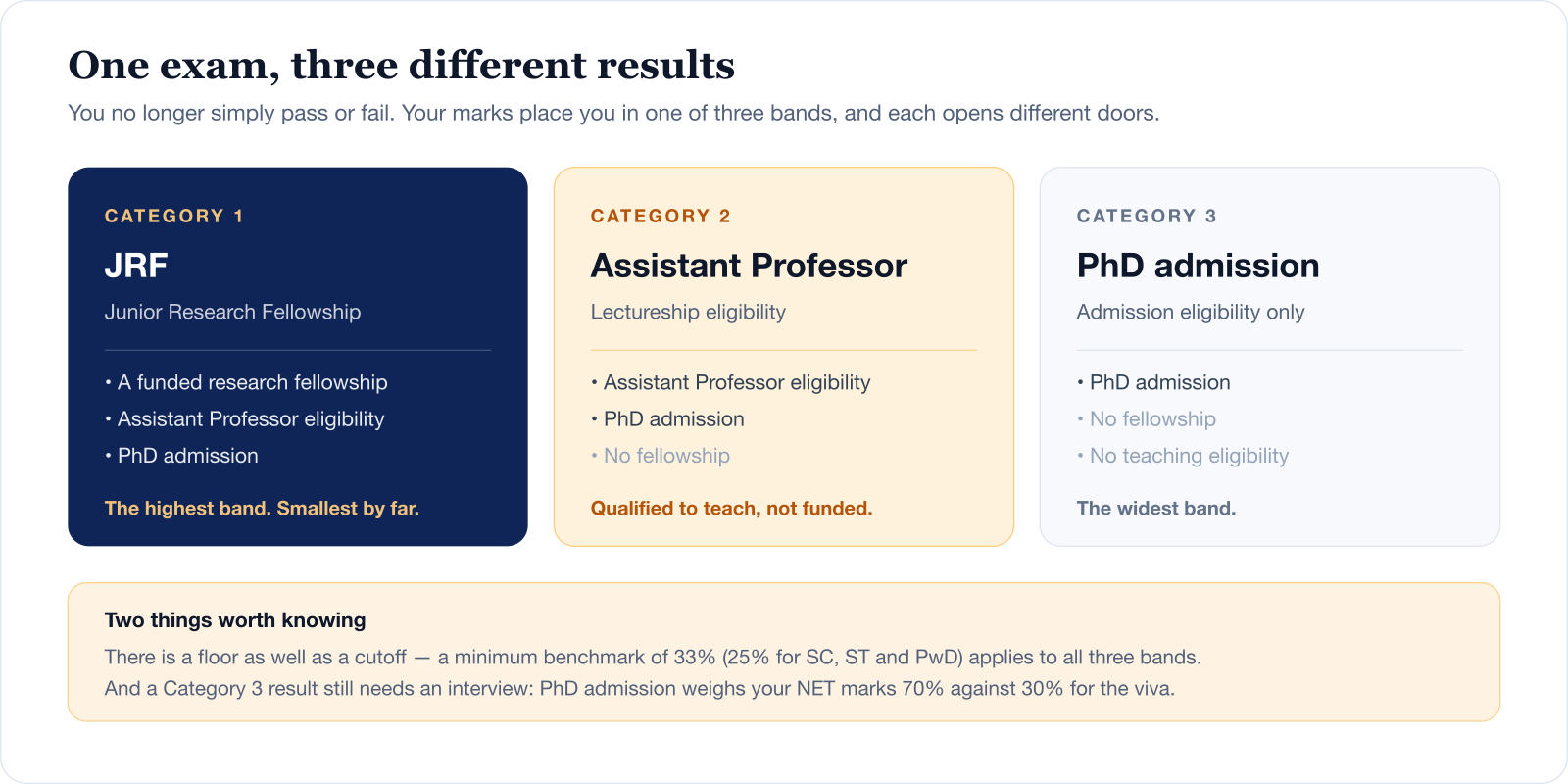
This is the single most misunderstood thing about the exam, and it is a fairly recent change. You do not simply pass or fail. Your marks place you in one of three bands.
| Category | What it gives you |
| Category 1 — JRF | A funded Junior Research Fellowship, plus Assistant Professor eligibility and PhD admission |
| Category 2 | Assistant Professor eligibility and PhD admission — but no fellowship |
| Category 3 | PhD admission only |
The cutoff for each band is published separately, by subject and by category, after every session. Category 1 is much the smallest — typically a low four-figure number of candidates across all five subjects. Category 3 is by some distance the largest.
Two details worth carrying with you. There is a floor as well as a cutoff: a minimum benchmark of 33% applies to all three bands, and 25% for SC, ST and PwD candidates. And a Category 3 result is not admission — PhD selection weighs your NET marks 70% against 30% for the interview, so the exam gets you to the interview rather than past it.
4. Who may sit it
| Rule | What it says |
| Qualifying degree | M.Sc. or an equivalent degree, with at least 55% marks (relaxed for reserved categories). Final-year students may apply. |
| Age — for JRF | An upper age limit applies, currently 30 years, with the usual relaxations for reserved categories and for women candidates. |
| Age — for Assistant Professor | No upper age limit at all. |
| Attempts | No limit. The exam is held twice a year and you may sit it as often as you remain eligible. |
| Subject | One subject per session. You choose it at registration. |
The age rule is the one to read carefully, because it does not apply uniformly. The upper age limit exists for the fellowship, not for the eligibility. A candidate past the JRF age limit can still sit the exam and still qualify for Assistant Professor and for PhD admission — they simply cannot be awarded the fellowship. That distinction decides a great many people’s plans and is frequently reported as a blanket “age limit for CSIR NET”, which it is not.
5. What the exam is actually testing
Three things, and they are not the same skill.
- Part A tests whether you can think outside your subject. Thirty marks of aptitude, identical for everyone, and the only part of the paper where a candidate from any of the five subjects can be beaten by preparation alone.
- Part B tests coverage. Whether you actually know the syllabus rather than the parts of it your course emphasised.
- Part C tests depth. It carries the most marks, takes the most time per question, and is where the JRF cutoff is really decided.
Because the paper prints more questions than you must attempt, and because the negative marking differs by subject and by part, which questions you answer is a decision the exam is deliberately asking you to make. How to make it well, and which topics carry the weight in each subject, are questions for the subject articles — this one is the ground you are standing on.
6. The five subjects, one guide each
Everything above holds for all five CSIR NET subjects. What does not hold across them is the thing that decides how you sit the paper: the number of questions, the marks each carries, the negative marking, and where the bar lands. Each subject has its own guide, built from eight sessions of official cutoffs.
| Subject | What its guide covers |
| Mathematical Sciences | The only paper with no penalty in Part C — and the only one where a question can have four right answers |
| Physical Sciences | The smallest paper, and the one that gives you the least room to skip |
| Chemical Sciences | A Part B that leaves five skips across the whole of chemistry |
| Life Sciences | Why its cutoff was a percentile, and what the DBT merger changes from December 2026 |
| Earth Sciences | The biggest paper, the highest bar, and the only Part C penalised at 33% |
Read this page for the rules of the exam, and your subject’s guide for what those rules cost in your paper.
Quick answers
Frequently asked
What is the difference between JRF, Assistant Professor and Category 3 in CSIR NET?
They are three bands of result from the same paper. Category 1 (JRF) brings a funded research fellowship plus Assistant Professor eligibility and PhD admission. Category 2 gives Assistant Professor eligibility and PhD admission but no fellowship. Category 3 gives PhD admission eligibility only.
Is there negative marking in CSIR NET?
Yes, but not uniformly — it differs by subject and by part. Mathematical Sciences has no negative marking in Part C, while other subjects do. Check your own subject’s section of that year’s information bulletin rather than a general figure.
Is Part A the same for all CSIR NET subjects?
Yes. Part A is General Aptitude and is identical in all five papers: 20 questions asked, attempt any 15, 2 marks each, for 30 of the 200 marks. It contains no science at all.
What is the age limit for CSIR NET?
The upper age limit applies to the fellowship, not to the exam. JRF has an upper age limit — currently 30 years, with the usual relaxations — while there is no upper age limit at all for Assistant Professor eligibility. A candidate past the JRF age can still sit and still qualify for the other two categories.
How many times can I appear for CSIR NET?
There is no limit on attempts. The exam is held twice a year and you may sit it as often as you remain eligible.
How many marks is CSIR NET and how long is the paper?
200 marks in three hours, in every subject. Part A is 30 marks of General Aptitude; Parts B and C are your subject and carry 170 marks between them.
Does qualifying CSIR NET mean I get a PhD seat?
No — it makes you eligible. PhD selection weighs your NET marks 70% against 30% for an interview or viva conducted by the university, so the exam gets you to the interview rather than past it.
What qualification do I need to apply for CSIR NET?
An M.Sc. or equivalent degree with at least 55% marks, relaxed for reserved categories. Final-year students may apply.
Keep reading