
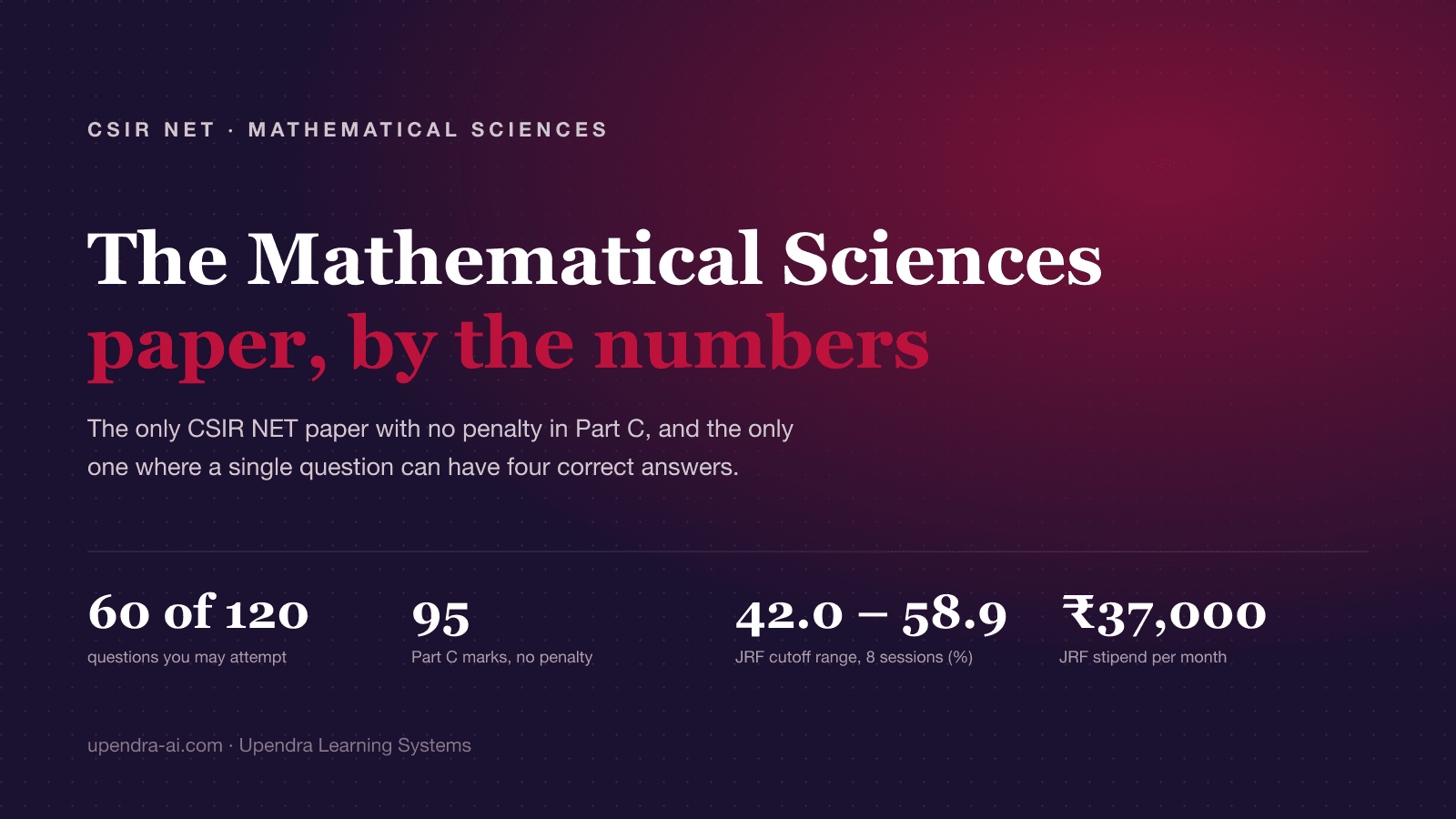
Mathematical Sciences is the paper CSIR NET treats differently from every other subject it runs. It is the only one of the five where Part C carries no negative marking, the only one where a Part C question can have more than one correct answer, and the only one where you attempt 60 questions instead of 75. Those three rules change how the paper should be attempted, and most preparation advice written for “CSIR NET” in general does not apply to it.
This article is about the Mathematical Sciences paper specifically: how it is built, what the syllabus really asks of you, and what eight sessions of official cutoffs — both the June and the December cycles — actually say.
If you have not sat CSIR NET before, the general guide to the exam covers what applies to all five subjects — the three result categories, eligibility and what each grade of result gives you. This page assumes them.
Which year is this data from? The exam pattern, marking scheme, eligibility rules, fee and stipend here are from the Joint CSIR-UGC NET June 2025 Information Bulletin published by the NTA. The cutoff series runs from June 2021 to December 2025, taken from the official cut-off notices on the CSIR-HRDG website. The Part C analysis is counted from the NTA final answer keys for June 2024, both December 2024 shifts and June 2025.
December 2025 is the most recent session whose result has been declared — it came out on 23 February 2026. This page is updated after each session rather than replaced, so older figures stay here beside the new ones.
1. How the paper is built
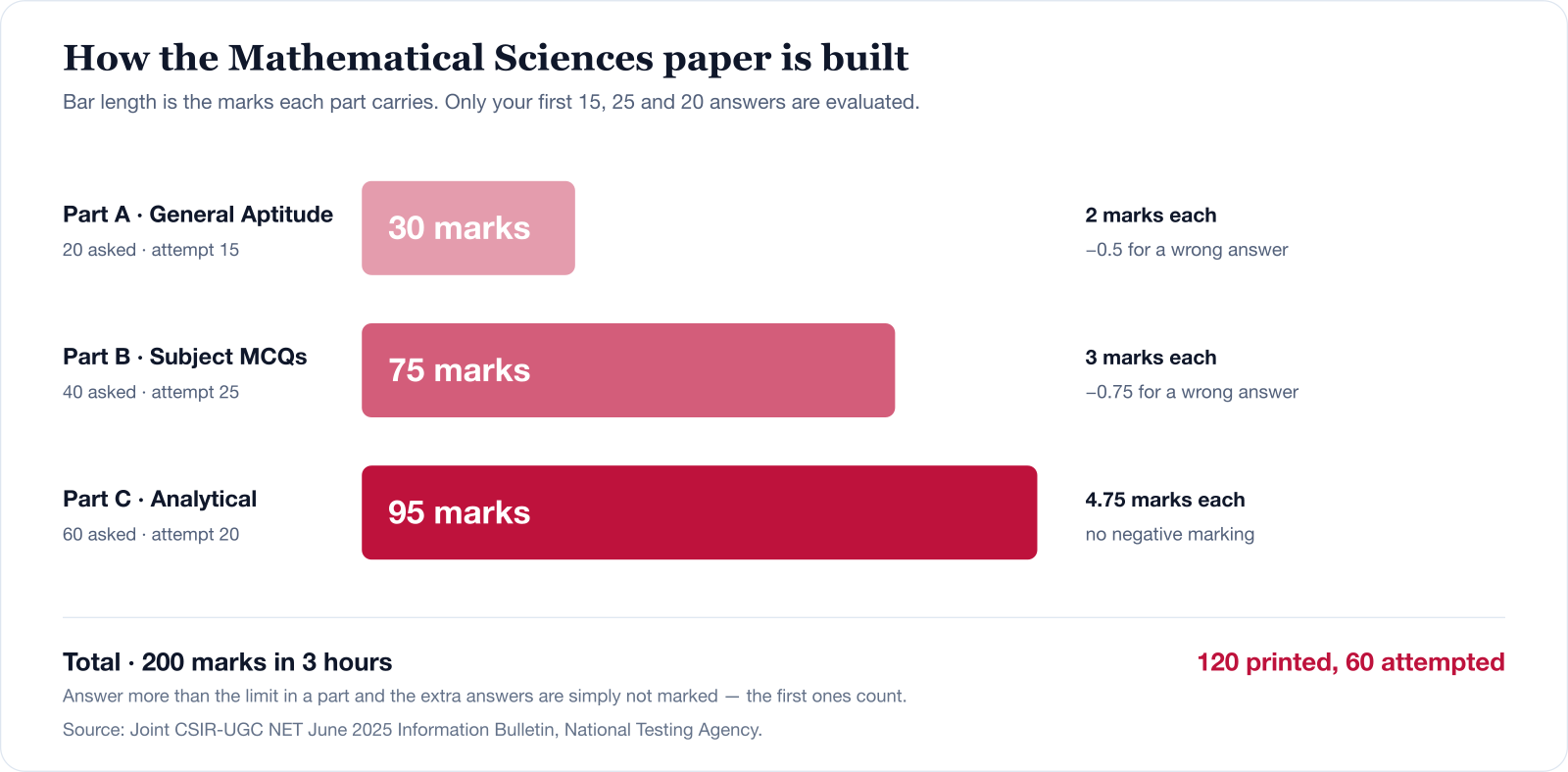
Three hours, 200 marks, three parts. The paper prints 120 questions and lets you answer 60 of them.
| Part | Asked | You attempt | Per question | Wrong answer | Marks |
| A — General Aptitude | 20 | 15 | +2 | −0.5 | 30 |
| B — Subject MCQs | 40 | 25 | +3 | −0.75 | 75 |
| C — Analytical | 60 | 20 | +4.75 | nothing | 95 |
| Total | 120 | 60 | 200 |
Two things in that table are easy to read past and expensive to get wrong.
Only your first 15, 25 and 20 answers are marked. The bulletin is explicit: if you answer more than the limit in a part, “only first 15, 25 and 20 questions in Part A, Part B and Part C respectively will be taken up for evaluation”. The extra answers are not wrong — they are simply not looked at. So the usual advice that follows from “no negative marking in Part C, so attempt everything” is not just useless here, it is actively harmful. Attempting 30 Part C questions means the 20 that count are the first 20 you happened to answer, not the 20 you were most confident about.
Part C is worth almost half the paper. Ninety-five of 200 marks sit in 20 questions, at 4.75 marks each — the most valuable single question in any CSIR NET paper. Part A and Part B together are 105 marks over 40 questions. Where you spend the three hours is decided by that arithmetic.
2. Part C is a different kind of question
In Parts A and B, four options are given and exactly one is correct. In Part C, the rule is different, and the bulletin states it plainly: each question may have one or more correct options, and credit is given only on identifying all the correct options. There is no partial credit. Getting three of four right scores the same as getting none right: zero.
That raises an obvious question — how often does a Part C question actually have more than one answer? It is answerable, because the NTA publishes the final answer key for every paper. Here is every Part C question from four recent papers, counted.
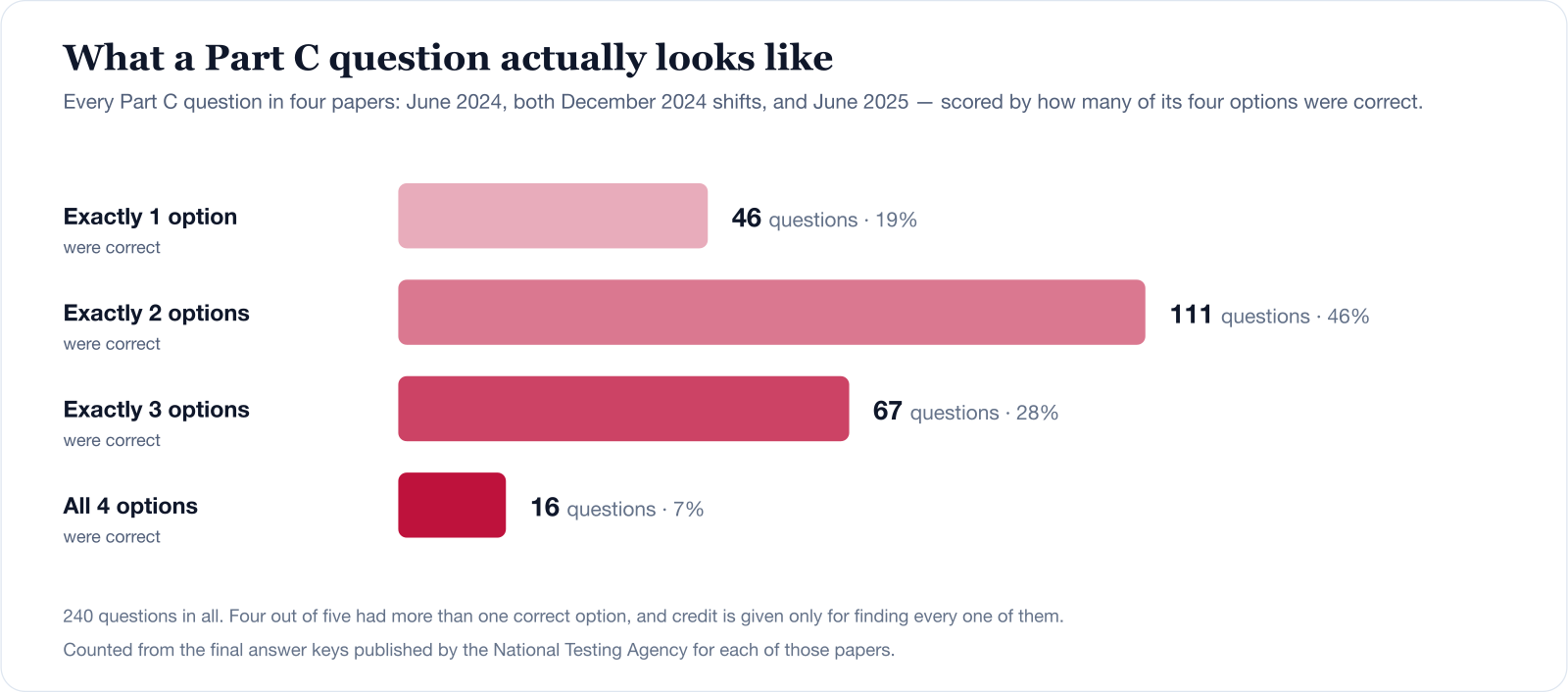
| Paper | 1 correct | 2 correct | 3 correct | All 4 correct |
| June 2024 | 13 | 26 | 17 | 4 |
| December 2024 — 28 Feb shift | 8 | 30 | 18 | 4 |
| December 2024 — 2 Mar shift | 15 | 27 | 15 | 3 |
| June 2025 | 10 | 28 | 17 | 5 |
| All 240 questions | 46 (19%) | 111 (46%) | 67 (28%) | 16 (7%) |
Four out of five Part C questions have more than one correct option, and in about one question in fourteen, every option is correct. Treating Part C as a single-answer MCQ — find the right one, move on — is the most common way to lose marks in this paper, because the moment you stop checking after finding one correct option, you have an 81% chance of scoring zero on that question.
The same numbers explain why “no negative marking” is not the invitation it sounds like. With four options, there are 15 possible non-empty answers to a Part C question. A blind guess lands on all of them at roughly 1 in 15. Combined with the rule that only your first 20 answers count, that means guessing is close to worthless in Part C. The absence of a penalty is there so that a well-reasoned partial insight costs you nothing to act on — not so that you can fill the sheet.
3. One syllabus, two tracks
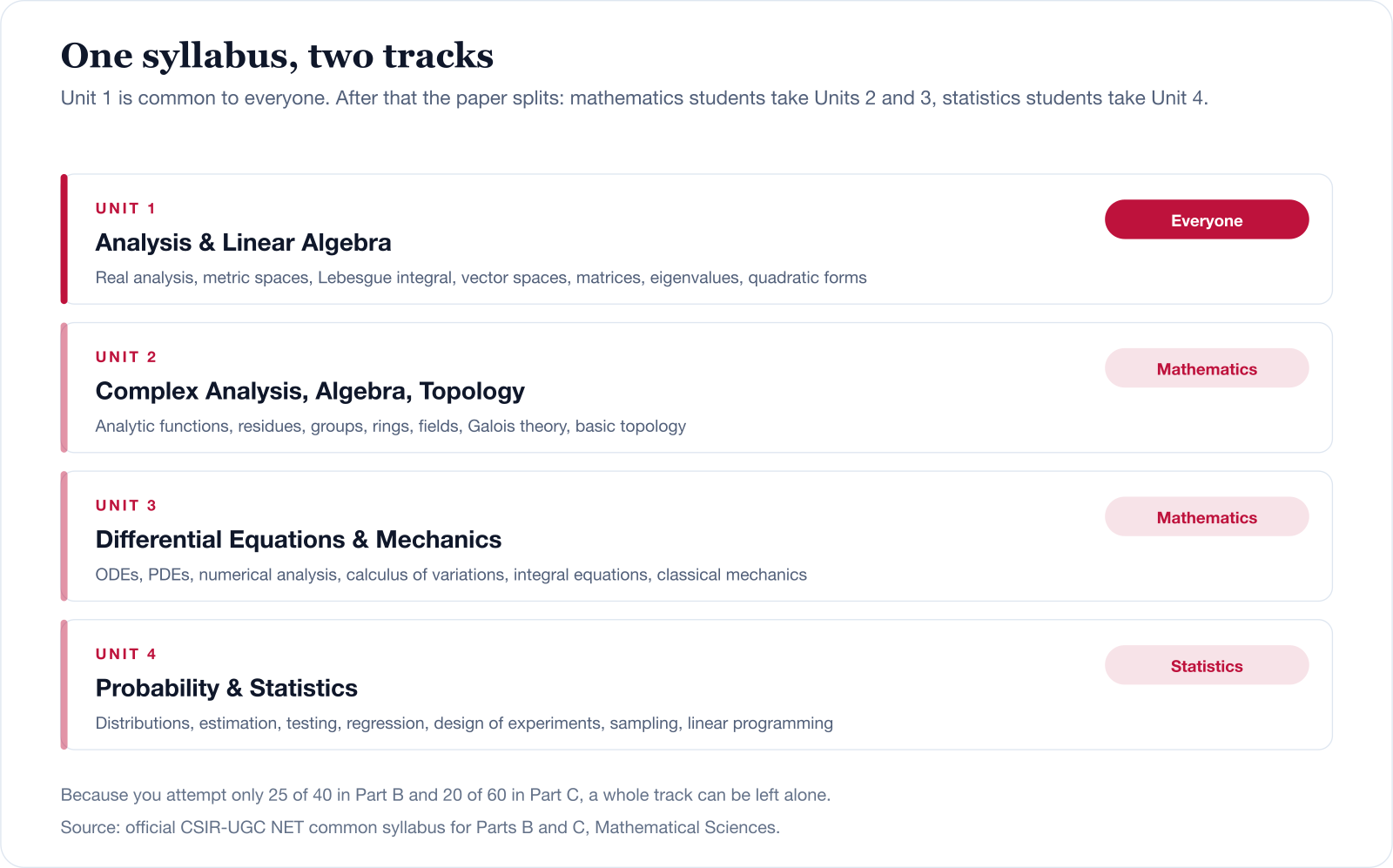
The official syllabus for Parts B and C is four units, and it ends with a sentence that decides most of a candidate’s preparation plan: “All students are expected to answer questions from Unit I. Students in mathematics are expected to answer additional questions from Unit II and III. Students in statistics are expected to answer additional questions from Unit IV.”
In other words, this is two exams sharing one question paper.
| Unit | Contents | Who it is for |
| Unit 1 | Real analysis, sequences and series, continuity and differentiability, Riemann and Lebesgue integration, metric spaces, functions of several variables; and linear algebra — vector spaces, matrices, rank, eigenvalues, canonical forms, inner product spaces, quadratic forms | Everyone |
| Unit 2 | Complex analysis (analytic functions, Cauchy’s theorem, residues, conformal mappings); algebra (number theory, groups, Sylow theorems, rings, ideals, fields, Galois theory); topology | Mathematics |
| Unit 3 | ODEs and PDEs, numerical analysis, calculus of variations, linear integral equations, classical mechanics | Mathematics |
| Unit 4 | Probability, distributions, estimation and testing, regression, multivariate analysis, sampling, design of experiments, linear programming and queuing | Statistics |
This structure is only usable because of the attempt limits. You answer 25 of 40 in Part B and 20 of 60 in Part C, so a statistics candidate can leave Units 2 and 3 alone and a mathematics candidate can leave Unit 4 alone, and either still has far more questions available than they are allowed to answer.
What nobody can leave alone is Unit 1. It is the only unit both tracks are told to answer from, it is the largest single block in the syllabus, and it is the one that decides the paper. Analysis and linear algebra are also the units most likely to appear inside a question that looks as if it belongs to another unit.
4. Eight sessions of cutoffs
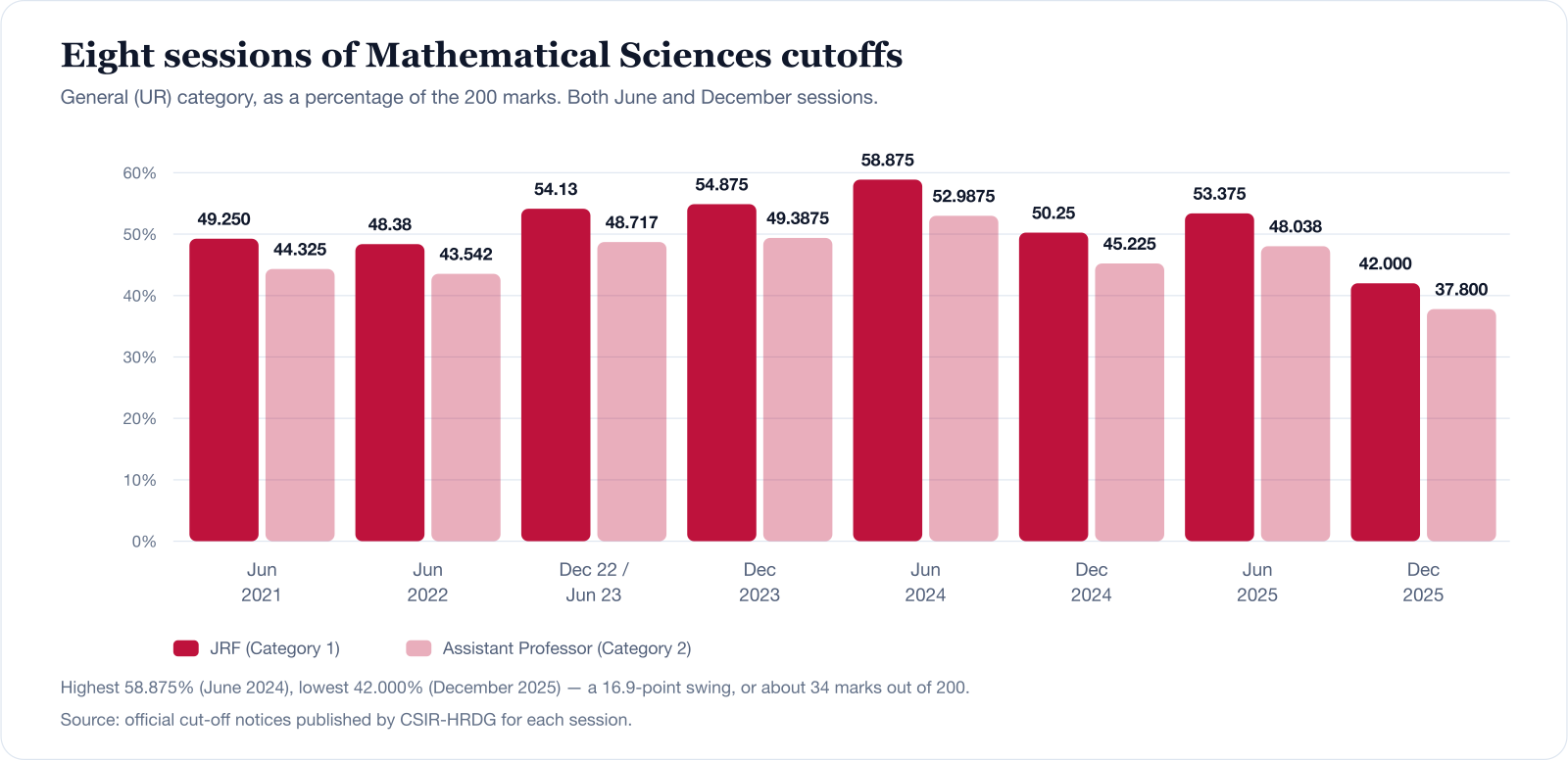
| Session | JRF (General) | Out of 200 | Asst. Professor (General) | PhD only (General) |
| June 2021 | 49.250% | 98.5 | 44.325% | — |
| June 2022 | 48.38% | 96.8 | 43.542% | — |
| Dec 2022 / June 2023 | 54.13% | 108.3 | 48.717% | — |
| December 2023 | 54.875% | 109.8 | 49.3875% | — |
| June 2024 | 58.875% | 117.8 | 52.9875% | not published |
| December 2024 | 50.25% | 100.5 | 45.225% | 36.5% |
| June 2025 | 53.375% | 106.8 | 48.038% | 38.375% |
| December 2025 | 42.000% | 84.0 | 37.800% | 33.000% |
Because the cutoff is a percentage of the same 200 marks every time, it converts straight into marks. The highest bar of these eight sessions, June 2024, was 117.75 marks out of 200. The lowest, December 2025, was 84 marks. That is a swing of nearly 34 marks — the difference between needing seven Part C questions right and needing none of them.
A higher cutoff means an easier paper, not a harder one. The bar is set after the exam, from how the cohort actually scored. June 2024’s 58.875% does not mean that session was brutal; it means enough candidates scored well that the bar landed high. December 2025’s 42% means the opposite. Last session’s number describes a paper you will not sit, which is why it is a poor target to prepare against.
The three results, and the arithmetic that links them
You do not pass or fail CSIR NET. Your marks put you in one of three bands, and each band has its own published cutoff. Here are the two most recent sessions in full, across every category.
| December 2025 | UR | EWS | OBC | SC | ST | PwD |
| Category 1 — JRF | 42.000 | 36.500 | 36.250 | 29.500 | 26.375 | 25.000 |
| Category 2 — Asst. Professor | 37.800 | 33.000 | 33.000 | 26.550 | 25.000 | 25.000 |
| Category 3 — PhD only | 33.000 | 33.000 | 33.000 | 25.000 | 25.000 | 25.000 |
| June 2025 | UR | EWS | OBC | SC | ST | PwD |
| Category 1 — JRF | 53.375 | 46.000 | 43.375 | 35.375 | 30.750 | 25.125 |
| Category 2 — Asst. Professor | 48.038 | 41.400 | 39.038 | 31.838 | 27.675 | 25.000 |
| Category 3 — PhD only | 38.375 | 33.000 | 33.000 | 26.000 | 25.000 | 25.000 |
Look down the Category 1 and Category 2 rows and a pattern appears that CSIR does not spell out anywhere: the Assistant Professor cutoff is exactly 90% of the JRF cutoff, in every category and every session. December 2025: 42.000 × 0.9 = 37.800. June 2025: 53.375 × 0.9 = 48.038. June 2024: 58.875 × 0.9 = 52.9875. It holds for all eight sessions above.
There is one qualification, and it is the floor. A minimum benchmark of 33% applies to General, EWS and OBC candidates and 25% to SC, ST and PwD candidates, for all three categories. Where 90% of the JRF figure would fall below that floor, the floor wins. In December 2025 the EWS JRF cutoff was 36.500, and 90% of it is 32.85 — so the Assistant Professor cutoff was published as 33.000, not 32.85.
The practical value of the rule is that you never need to wait for your category’s number. Take the General JRF figure, multiply by 0.9, and apply the floor.
What each result actually gives you
| Category 1 — JRF | A funded fellowship of ₹37,000 a month for the first two years, plus a ₹20,000 annual contingency grant. On registering for a PhD and clearing a review, it rises to ₹42,000 from the third year. Also carries Assistant Professor eligibility and PhD admission. |
| Category 2 | Assistant Professor eligibility and PhD admission. No fellowship. |
| Category 3 | PhD admission only. |
Category 3 is by far the largest of the three. In the December 2025 session — across all five subjects — 8,035 candidates qualified for PhD admission only, 2,941 for Category 2, and about 3,370 for a fellowship. In June 2025 the same figures were 9,232, 2,886 and roughly 2,890. The fellowship is a small door at the top of a much wider staircase.
5. Two shifts, one cutoff
Whether Mathematical Sciences runs in one shift or two depends on the session, and it changes nothing about the cutoff — but the reason it changes nothing is worth understanding.
| Session | When it was actually held | Shifts for Mathematical Sciences |
| June 2021 | 29 January to 17 February 2022 | — |
| June 2024 | 25, 26 and 27 July 2024 | One |
| December 2024 | 28 February, 1 and 2 March 2025 | Two — 28 February and 2 March |
| June 2025 | 28 July 2025 | One (Shift 2) |
| December 2025 | 18 December 2025 | One |
In December 2024, Mathematical Sciences candidates sat two entirely different papers on two different days, and the NTA published two separate answer keys for them. Yet only one cutoff was published for the subject: 50.25% for General JRF.
The bulletin explains how. When a subject runs in multiple shifts, raw marks are converted to percentile scores, the shifts are merged, and — in the NTA’s own words — if the percentiles for the shifts come out unequal, “the lowest will be the eligibility cut-off for that category for all candidates”. The rule is deliberately generous: it protects whichever shift got the harder paper rather than averaging the two.
So there is nothing to plan for here. You cannot choose your shift, a harder shift is not a disadvantage you have to make up, and there is no separate “shift 1 cutoff” to look for — only one number per subject, per category, per session.
One more rule in the same family, from every cut-off notice CSIR publishes: there is no separate cutoff for Part A, B or C. Only the cumulative total decides the merit list. You do not have to clear a bar in each part.
6. Who may sit it
| Rule | What it says |
| Qualifying degree | A Master’s degree with at least 55% marks — 50% for OBC-NCL, SC, ST, PwD and third-gender candidates. Final-year students may apply and are admitted provisionally. |
| Four-year bachelor’s degree | Eligible with 75% in aggregate (relaxed by 5% for reserved categories). Such candidates can qualify for JRF and PhD admission, but not for Assistant Professor. |
| Age — for JRF | Not more than 30 years as on the first day of the month in which the exam concludes, with up to 5 years’ relaxation for OBC-NCL, SC, ST, PwD, third-gender and women candidates, and for research or armed-forces experience. |
| Age — for Assistant Professor and PhD | No upper age limit at all. |
| Attempts | No limit. Held twice a year. |
| Application fee | ₹1,150 General · ₹600 EWS and OBC-NCL · ₹325 SC, ST, PwD and third gender. |
The age rule is the one most often reported wrong. The limit exists for the fellowship, not for the exam. A candidate past 30 can sit the paper, qualify, and be certified for Assistant Professor and for PhD admission — they simply cannot be awarded the JRF.
The four-year-degree row is the newest and the least understood. It opens the exam to candidates who have not done a Master’s at all, and it lets them sit the paper in whichever subject they intend to do a PhD in, regardless of what their bachelor’s degree was in. What it does not give them is Assistant Professor eligibility.
7. What this paper is actually asking for
- Choose your 20 Part C questions before you answer any of them. Only the first 20 you answer are marked, so the read-through is not wasted time — it is the single highest-value twenty minutes in the exam.
- Never stop at one correct option in Part C. Four out of five questions have more than one, and partial credit does not exist. Every option has to be ruled in or out.
- Do not guess in Part C. No penalty is not the same as free marks: a blind guess is worth about 1 in 15, and it consumes one of your 20 evaluated answers.
- Guard Parts A and B properly. They are the only places a wrong answer costs you anything — and a wrong Part B question swings 3.75 marks once you count the 3 you did not get.
- Unit 1 is not optional for anyone. Both tracks answer from it, and analysis and linear algebra turn up inside questions that look as if they belong somewhere else.
- Do not prepare against last session’s cutoff. It has ranged from 84 to 118 marks out of 200 in eight sessions, and it is a description of a paper that has already been written.
- Do not ignore Part A. Thirty marks of general aptitude, no mathematics in it at all, identical for every subject — and the cheapest marks in the paper for anyone willing to practise them.
The syllabus is public and every candidate has the same one. What separates a Category 1 result from a Category 3 result is almost entirely Part C: which twenty questions you choose, and how completely you answer them.
Quick answers
Frequently asked
Is there negative marking in CSIR NET Mathematical Sciences?
In Parts A and B only. A wrong Part A answer costs 0.5 marks and a wrong Part B answer costs 0.75 — 25% of the question. Part C, which carries 95 of the 200 marks, has no negative marking at all. Mathematical Sciences is the only CSIR NET subject where Part C is penalty-free.
How many questions do I have to attempt in CSIR NET Mathematical Sciences?
60 of the 120 printed: 15 of 20 in Part A, 25 of 40 in Part B and 20 of 60 in Part C. If you answer more than the limit in a part, only the first 15, 25 and 20 answers are evaluated — the rest are not marked at all.
Can a Part C question have more than one correct answer?
Yes, and usually it does. Across 240 Part C questions from the June 2024, both December 2024 shifts and June 2025 papers, 19% had exactly one correct option, 46% had two, 28% had three and 7% had all four. Credit is given only if you identify every correct option — there is no partial credit.
What was the CSIR NET Mathematical Sciences cutoff in December 2025?
For the General category, 42.000% for JRF (Category 1), 37.800% for Assistant Professor (Category 2) and 33.000% for PhD admission only (Category 3). Because the cutoff is a percentage of the 200 marks, the JRF figure works out at 84 marks. It was the lowest of the last eight sessions.
How are the category cutoffs for CSIR NET decided?
The Assistant Professor cutoff is exactly 90% of the JRF cutoff in the same category, subject to a floor: a minimum benchmark of 33% for General, EWS and OBC candidates and 25% for SC, ST and PwD candidates. Where 90% would fall below the floor, the floor is published instead.
What happens if the exam is held in two shifts?
Nothing you need to plan for. Raw marks from the different shifts are converted to percentile scores and merged, and if the percentiles come out unequal the NTA uses the lower one as the cutoff for every candidate in that category. Only one cutoff is published per subject per session — December 2024 ran Mathematical Sciences in two shifts and still published a single figure of 50.25%.
Do I need to clear a separate cutoff in Part A, B and C?
No. Every CSIR cut-off notice states it explicitly: there is no separate cutoff for Part A, B or C. Only the cumulative total across all three parts is used to draw the merit list.
Do I have to study the statistics unit?
Not if you are a mathematics candidate. The official syllabus says everyone answers from Unit 1, mathematics students take Units 2 and 3, and statistics students take Unit 4. Because you attempt only 25 of 40 questions in Part B and 20 of 60 in Part C, either track leaves you far more questions than you are allowed to answer.
How much is the CSIR NET JRF stipend?
₹37,000 a month for the first two years, plus a contingency grant of ₹20,000 a year. On registering for a PhD and clearing an assessment, it rises to ₹42,000 a month from the third year.
Is there an age limit for CSIR NET Mathematical Sciences?
Only for the fellowship. JRF has an upper age limit of 30 years as on the first day of the month in which the exam concludes, relaxed by up to five years for OBC-NCL, SC, ST, PwD and third-gender candidates, for women, and for research or armed-forces experience. There is no upper age limit at all for Assistant Professor eligibility or for PhD admission.
Keep reading