
The Mathematics paper — paper code MA — is one of the seven IIT JAM papers, and it behaves differently from the others in ways that matter. It has the mildest marking scheme of the set, the most volatile cutoff, and a gap between qualifying and admission that catches out more candidates than any other single thing about this exam.
This article is about that paper specifically: what it contains, what the numbers from the last nine years actually say, and what any of it means for how you prepare.
If you have not sat IIT JAM before, the general guide to the exam covers the rules that apply to all seven papers — the marking scheme, eligibility and how admission actually works. This page assumes them.
Which year is this data from? Every figure here is from the IIT JAM 2025 cycle — the 2025 seat matrix, and the qualifying cutoffs declared with the 2025 result — with the cutoff series running back to JAM 2021. The exam pattern, marking scheme and eligibility rules are as they stand now. The cutoff chart below runs back to JAM 2017.
This page is updated after each year’s result rather than replaced, so the older figures stay here beside the new ones. A single year tells you where the bar was; five years tell you how far it moves, which is the more useful thing to know while you are preparing.
1. Where the Mathematics paper sits
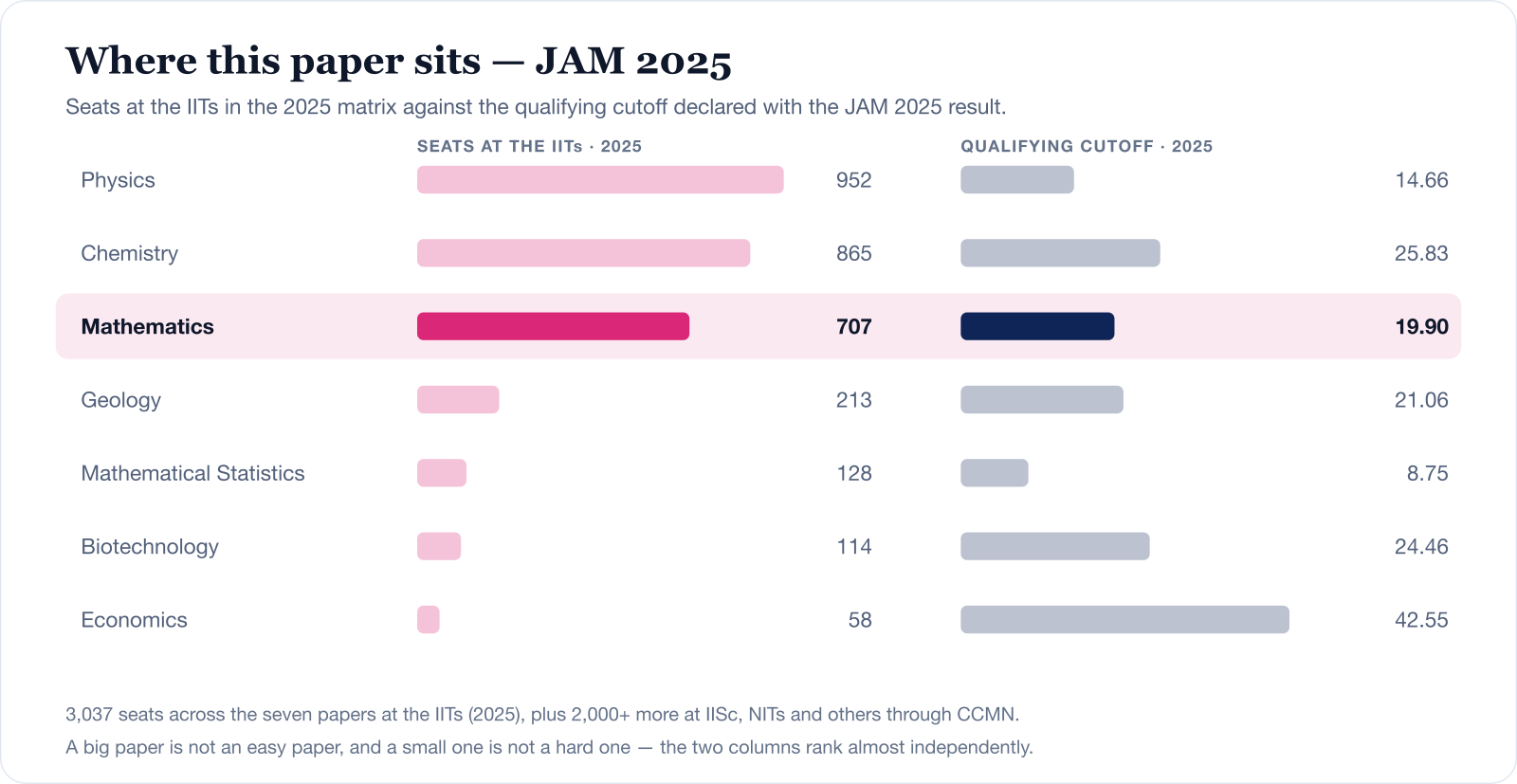
Mathematics is the third-largest of the seven papers by seats, and its cutoff sits mid-table. The two columns rank almost independently — a big paper is not an easy one, and a small one is not a hard one.
2. The paper you will actually sit
MA follows the standard JAM structure — three sections, 60 questions, 100 marks, three hours — but the section rules are what make it what it is.
| Section | Type | Questions | Marks | Negative marking |
| A | Multiple choice | 30 | 50 | −1/3 and −2/3 |
| B | Multiple select | 10 | 20 | None |
| C | Numerical answer | 20 | 30 | None |
Fifty of the hundred marks carry no penalty for a wrong answer. That is the most important line in this article. In Sections B and C, a blank and a wrong answer score identically — zero — so leaving a numerical question untouched costs exactly as much as an attempt that turns out to be wrong, and gains nothing.
Section A is where care is needed, and it is worth doing the arithmetic once. A wrong 2-mark MCQ takes two-thirds of a mark off, so the swing between getting it right and getting it wrong is 2⅔ marks. That is more than a whole 2-mark question. In a paper where the qualifying cutoff has sat between eleven and twenty marks in recent years, three careless MCQs are not a rounding error.
One more rule that decides Section B: there is no partial credit. If a question has three correct options and you tick two, you score zero — identically to having ticked nothing. Being 70% sure is worth nothing here, and that is a different skill from the one Section A tests.
3. What nine years of cutoffs actually show
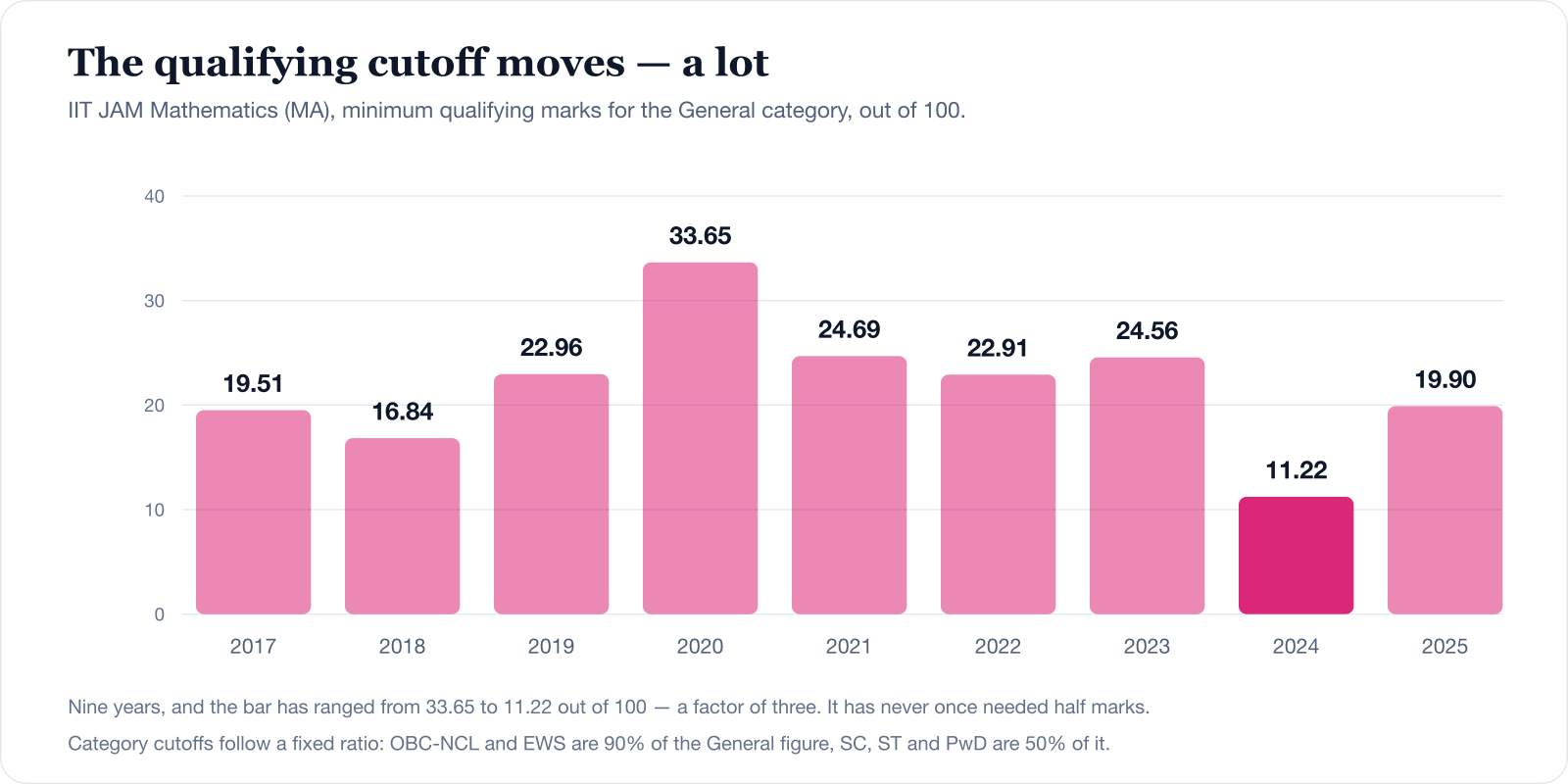
Two things jump out of that chart, and both change how you should think about the exam.
The first is how low the bar is. The qualifying cutoff for the General category has never once needed half marks. It peaked at 33.65 in 2020 and bottomed at 11.22 in 2024 — barely a ninth of the paper. Candidates routinely assume they need to be scoring 60 or 70 to have any business sitting this exam. To appear on the merit list, they do not.
The second is how much it moves. From 33.65 to 11.22 is a factor of three, and it is not noise — it is the difference between a hard paper and a very hard one, absorbed by the cutoff rather than by the candidates. 2024 was the outlier; 2025 came back up to 19.90.
Category cutoffs are not set separately. They follow a fixed ratio off the General figure:
| Category | Share of the General cutoff | 2025 | 2024 | 2020 (the peak) |
| General | 100% | 19.90 | 11.22 | 33.65 |
| OBC-NCL / EWS | 90% | 17.91 | 10.09 | 30.29 |
| SC / ST / PwD | 50% | 9.95 | 5.61 | 16.82 |
Because the ratio is fixed, you never need to look up your category’s number separately — take the General cutoff and halve it, or take 90% of it. And because the cutoff is set after the paper, it is a measure of how hard that year’s paper turned out to be, not a target you can aim at while preparing.
4. The number that actually matters
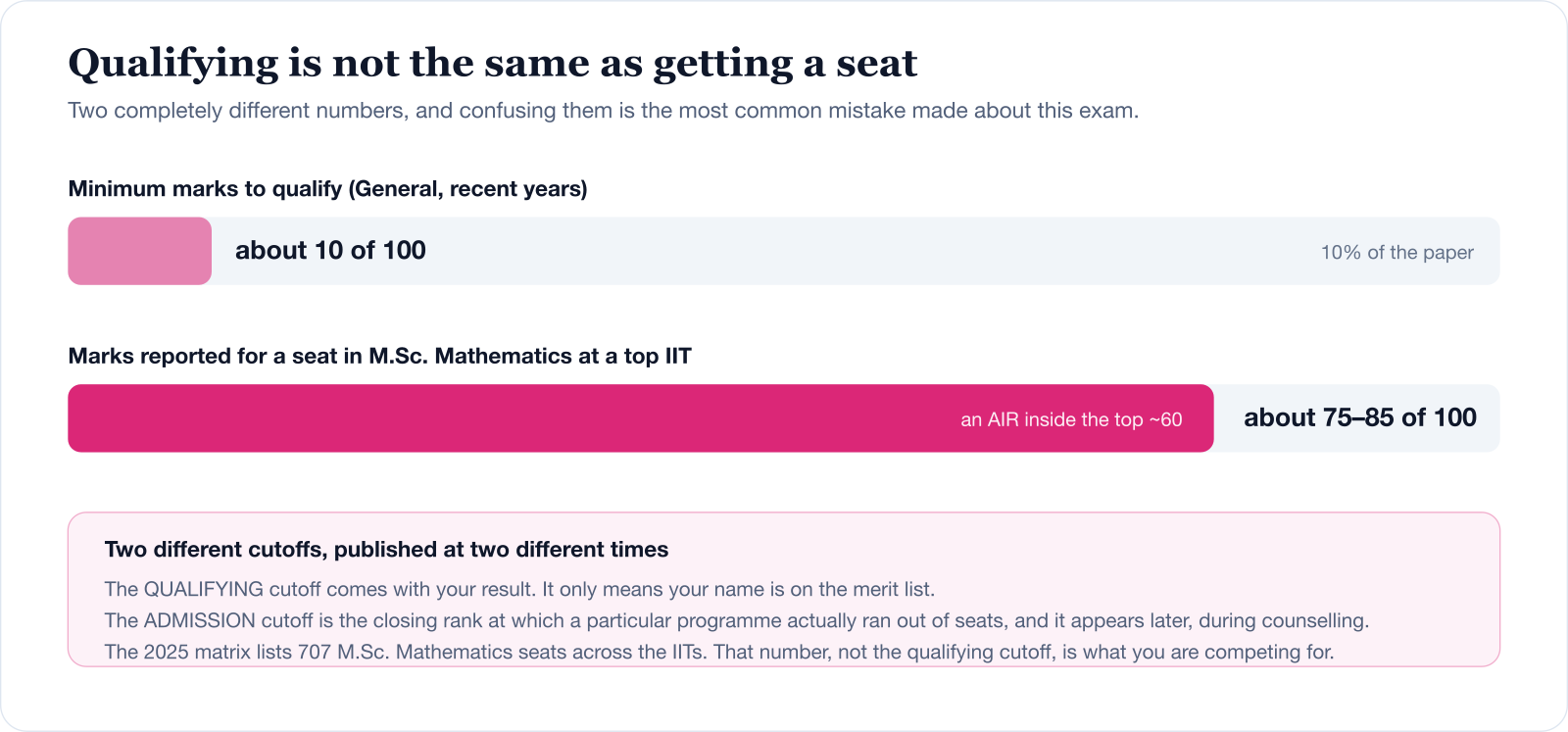
Here is where most of the confusion about this exam lives. There are two cutoffs, published months apart, and they are not remotely the same number.
The qualifying cutoff arrives with your result. Clearing it means one thing only: your name is on the All India merit list. It is the ten-mark bar in the chart above.
The admission cutoff is the closing rank at which a particular programme at a particular institute ran out of seats, and it appears later, during counselling. For M.Sc. Mathematics at the most competitive IITs, reported closing ranks sit inside roughly the top 60 All India — which corresponds to something in the region of 75 to 85 marks out of 100.
The 2025 seat matrix lists 707 M.Sc. Mathematics seats across the IITs, out of 3,037 for all seven papers — with a further 2,000-plus at IISc, NITs and other institutes filled from JAM scores through CCMN. That seat count, not the qualifying cutoff, is what you are competing for. Qualifying at 12 marks and expecting an IIT Bombay seat are two entirely different propositions, and the gap between them is most of this exam.
5. The syllabus, and what carries the paper
The MA syllabus is built on standard B.Sc. mathematics. It is short enough to read in one sitting, and doing so is worth more than any summary of it — including this one.
| Block | What it covers |
| Real Analysis | Sequences and series of real numbers, convergence, Cauchy sequences, Bolzano–Weierstrass, tests of convergence, power series |
| Functions of one real variable | Limits, continuity, differentiability, mean value theorems, Taylor’s series, maxima and minima |
| Functions of two or three variables | Limits, continuity, partial derivatives, maxima and minima |
| Integral Calculus | Double and triple integrals, change of order, areas and volumes |
| Differential Equations | First-order ODEs, integrating factors, Bernoulli, linear ODEs with constant coefficients, Cauchy–Euler |
| Vector Calculus | Gradient, divergence, curl, line and surface integrals, Green’s, Stokes’ and Gauss’s theorems |
| Group Theory | Groups, subgroups, cyclic and permutation groups, normal subgroups, Lagrange’s theorem, homomorphisms |
| Linear Algebra | Vector spaces, basis and dimension, linear transformations, matrices, rank, eigenvalues and eigenvectors |
A word about “topic-wise weightage”
You will find a great many tables online claiming to give the exact marks each topic carries. Read three of them and you will find they disagree with one another, sometimes substantially — because they are reconstructions of past papers, made by different people who classified the same question differently, and because the distribution genuinely shifts from year to year.
What is reliably true across papers is coarser, and more useful:
- Analysis and calculus together dominate. Real analysis, functions of one and several variables, and integral calculus account for the largest single share of the paper — comfortably more than a third of it in most years.
- Linear algebra is the next heaviest block, and the most mechanical. It rewards practice more directly than anything else in the syllabus.
- Group theory, differential equations and vector calculus each carry a smaller but consistent share. None of them is optional; none of them is where the paper is won.
Treat that as the shape of the paper rather than a budget. A topic that carried four marks last year can carry ten this year, and building a plan around one coaching site’s reconstruction is how candidates end up under-prepared in a block that happened to be light the year they studied it.
6. What the numbers imply for preparation
Take the three findings above together and they say something fairly specific.
- Do not skip Section C. Thirty marks, no penalty, no options to work backwards from. It is the section where preparation converts most directly into marks, and the only reason to leave one blank is that you have run out of time.
- Be disciplined in Section A and nowhere else. It is the only section that punishes a guess. Applying Section A caution to Sections B and C — leaving things blank to be safe — costs marks that were free.
- Prepare for the paper, not for the cutoff. The qualifying bar is set after the fact and has moved by a factor of three within nine years. It is not something you can aim at.
- Aim at the rank, because that is what the seat is priced in. 707 M.Sc. Mathematics seats across the IITs, and the good ones close inside the top 60. If an IIT seat is the goal, the target is 75-plus out of 100, not the ten marks that put you on the list.
- Sit full papers under a clock. Sixty questions in 180 minutes is three minutes each, across three sections with three different marking rules. Deciding what to attempt is a skill that only exists when the clock is running, and it cannot be learned from a question bank.
The syllabus is public and everybody preparing has the same one. What separates ranks is how many of the free marks you actually collect, and how few of the penalised ones you give away.
Quick answers
Frequently asked
What is the qualifying cutoff for IIT JAM Mathematics?
It changes every year and is set after the paper. Over the last nine years the General-category cutoff has ranged from 33.65 out of 100 in 2020 down to 11.22 in 2024, with 19.90 in 2025. It has never required half marks.
How are the category cutoffs for IIT JAM Mathematics decided?
By a fixed ratio off the General figure — OBC-NCL and EWS are 90% of it, and SC, ST and PwD are 50% of it. So if the General cutoff is 19.90, the SC/ST figure is 9.95.
Is there negative marking in IIT JAM Mathematics?
Only in Section A. A wrong 1-mark MCQ costs one-third of a mark and a wrong 2-mark MCQ costs two-thirds. Sections B and C — 50 of the 100 marks — carry no negative marking, so a blank and a wrong answer score exactly the same.
How many marks do I need for an M.Sc. Mathematics seat at an IIT?
Far more than the qualifying cutoff. Reported closing ranks for the most competitive IITs sit inside roughly the top 60 All India, which corresponds to about 75 to 85 marks out of 100. Qualifying at 12 marks and getting a seat at a top IIT are two different propositions.
How many M.Sc. Mathematics seats are there at the IITs?
707 across the IITs in the 2025 seat matrix, out of 3,037 for all seven papers, with 2,000-plus more at IISc, NITs and other institutes through CCMN. That seat count, rather than the qualifying cutoff, is what you are competing for.
Which topics carry the most marks in IIT JAM Mathematics?
Analysis and calculus together — real analysis, functions of one and several variables, and integral calculus — take the largest share, comfortably over a third in most years, with linear algebra next. Published topic-wise weightage tables disagree with each other because they are reconstructions of past papers, so treat any of them as the shape of the paper rather than a budget.
Is there partial credit in Section B of the MA paper?
No. You must select every correct option and no incorrect one. Ticking two of three correct options scores zero, exactly the same as ticking nothing.
What is the syllabus for IIT JAM Mathematics?
Real analysis, functions of one and of several real variables, integral calculus, differential equations, vector calculus, group theory and linear algebra — all at standard B.Sc. level. The official syllabus is published with each year’s brochure and is short enough to read in one sitting.
Tagged
Keep reading