
GATE — the Graduate Aptitude Test in Engineering — is the exam that sits between a bachelor’s degree and three quite different futures: a funded postgraduate degree at an IIT or IISc, a PhD, or a job at a public sector company. One paper does all three, which is unusual, and it is why the exam is written by final-year students and working engineers alike.
This is the general guide: how the paper is built, how it is marked, who may sit it, and what a GATE score is actually used for. Paper-by-paper syllabus and strategy are separate articles.
1. One exam, three destinations
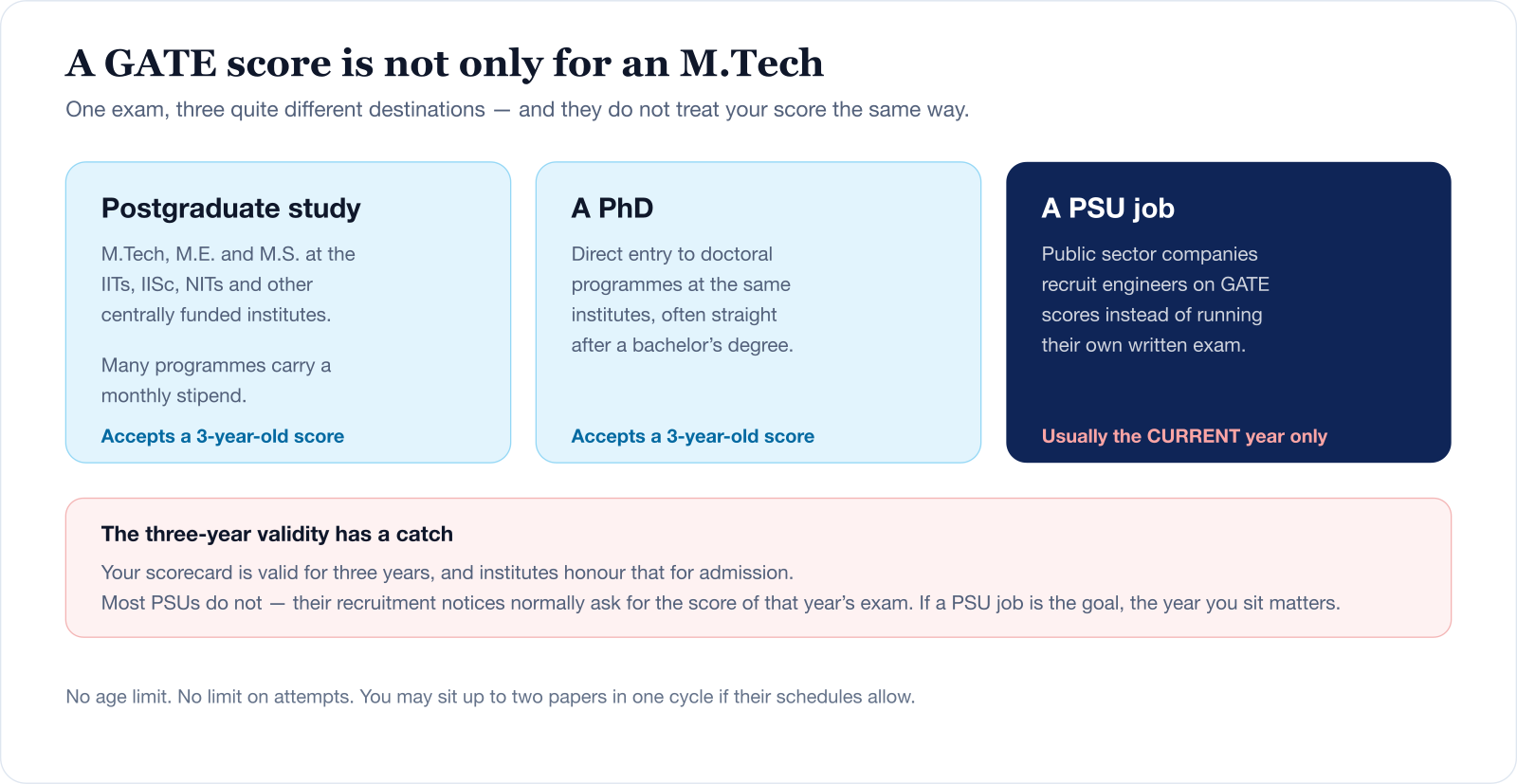
Most guides describe GATE as an M.Tech entrance exam. It is that, and it is two other things as well, and they do not treat your score the same way.
| What it is used for | How the score is treated |
| M.Tech, M.E. and M.S. at IITs, IISc, NITs and other centrally funded institutes | A three-year-old score is accepted. Many programmes carry a monthly stipend. |
| PhD admission at the same institutes | A three-year-old score is accepted. Often available directly after a bachelor’s degree. |
| Recruitment by public sector companies | Usually the current year’s score only. |
The three-year validity has a catch that costs people a year. Your scorecard is valid for three years and institutes honour that. Most PSUs do not — their recruitment notices normally ask for the score from that year’s exam. If a PSU job is the goal, the year you sit is part of the plan, not a detail.
2. How the paper is built
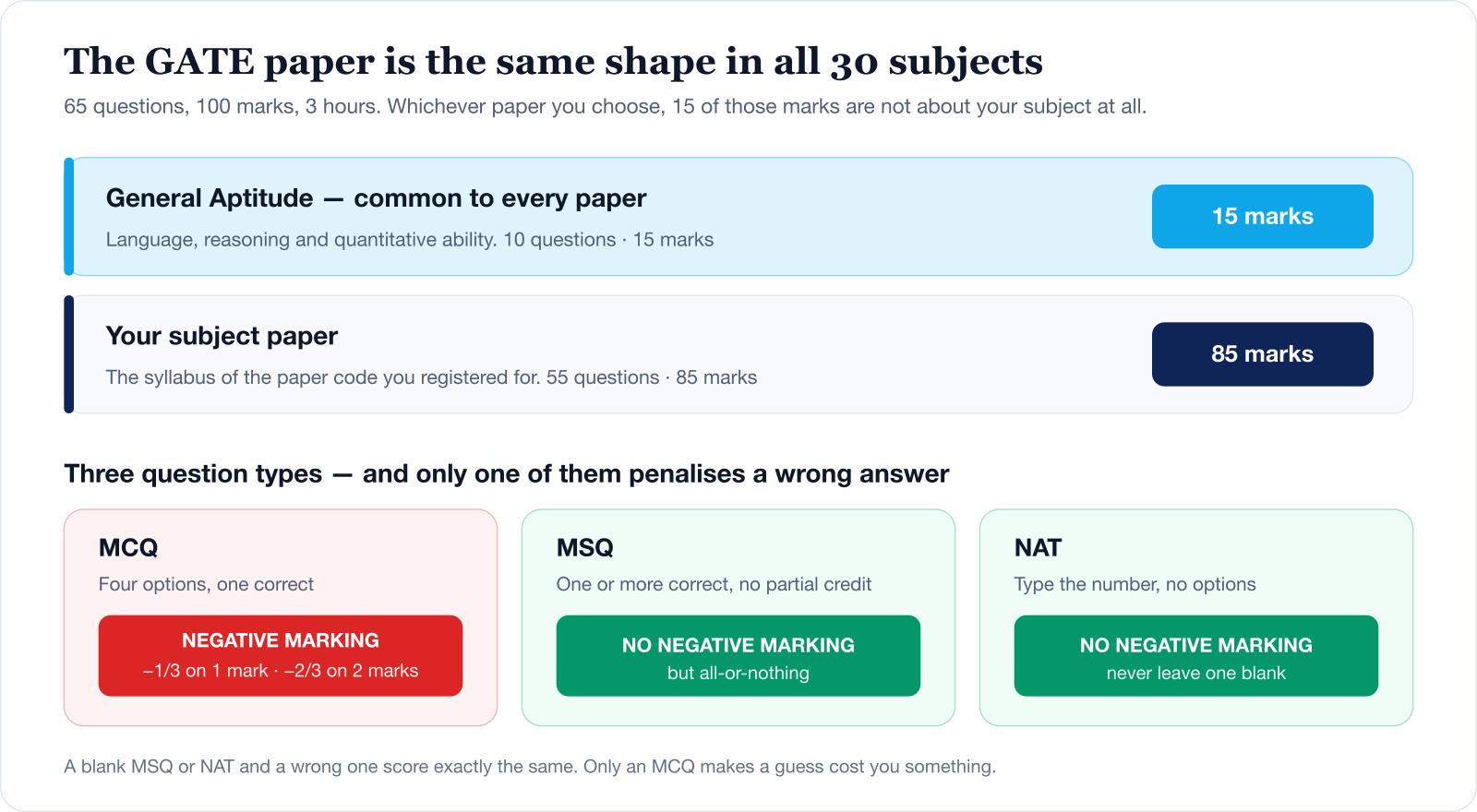
GATE runs to about thirty separate papers, one per subject, and you register for the one you want. Whichever you choose, the shape is identical: 65 questions, 100 marks, three hours, on a computer.
| Section | Questions | Marks |
| General Aptitude — common to every paper | 10 | 15 |
| Your subject paper | 55 | 85 |
| Total | 65 | 100 |
Fifteen of your hundred marks, in other words, have nothing to do with engineering. General Aptitude is language, reasoning and quantitative ability, it is the same section for a civil engineer and a computer scientist, and candidates routinely leave it unprepared on the grounds that it is “only fifteen marks” — in an exam where ranks are separated by fractions.
The three question types, and where a guess costs you
| Type | What it is | Negative marking |
| MCQ | Four options, exactly one correct | Yes — −1/3 on a 1-mark question, −2/3 on a 2-mark question |
| MSQ | One or more options correct | None — but no partial credit either |
| NAT | Type the number; no options | None |
That table has a practical consequence worth stating outright: a blank MSQ and a wrong MSQ score exactly the same, and so do a blank and a wrong NAT. There is never a reason to leave one of those empty. The MCQ section is the only place in the paper where being wrong is worse than being silent.
MSQ carries its own trap in the other direction. With no partial credit, knowing that two of four options are correct is worth nothing unless you can also rule on the other two — it is a format that punishes half-knowledge more sharply than a plain MCQ does.
3. Who may sit it
| Rule | What it says |
| Qualifying degree | Currently in the third year or higher of any undergraduate degree, or already holding one. |
| Age limit | None. |
| Attempts | No limit. Sit it as many times as you like. |
| Two papers | You may appear in up to two papers in one cycle, if their schedules allow. |
| Nationality | Indian nationals, and candidates from a small list of other countries. |
The third-year rule is worth noticing because it changes when you should start. You do not need your degree in hand — a student in the third year of a four-year programme can sit GATE, and a good score obtained then is valid for three years, which covers the whole window in which they might want to use it.
What GATE does not have is almost as important. No age limit and no attempt limit means nothing about a gap, a job, or a previous attempt disqualifies you. The constraint that does exist is the PSU one above: the exam is always open, but a PSU-focused attempt has to be timed.
4. The syllabus, in general terms
Each paper has its own syllabus, published by the organising institute, and General Aptitude is common to all of them. Two things are true of the subject syllabi generally.
The first is that they are built on the standard undergraduate curriculum of that discipline rather than on anything beyond it — GATE tests the degree you did, in more depth than your university examined it. The second is that the syllabus is revised: topics are added and removed between years, and papers are occasionally added to the list. Working from a coaching module that predates the current syllabus is a common and entirely avoidable way to study topics the exam has dropped.
Read your paper’s official syllabus for the year you are sitting before you buy a single book.
5. What the exam is actually asking for
- Breadth across your own degree. Fifty-five subject questions across an entire discipline means no chapter is reliably safe to skip, and depth in one area cannot compensate for a hole in another.
- Judgement about the marking scheme. Two of the three question types cost nothing to attempt. Recognising which type you are looking at, and answering accordingly, is worth marks on its own.
- Fifteen marks of something else entirely. General Aptitude is the cheapest section in the paper to improve and the most commonly ignored.
Sixty-five questions in three hours is under three minutes each, and the paper is built so that few candidates attempt everything comfortably. Which questions you leave is part of the exam.
How to prepare for a particular paper, which topics carry the most weight, and how to actually attempt three hours of it — those are subject-by-subject questions, and we will take them up in their own articles. This one is the map.
6. The papers, one guide each
GATE runs about thirty papers and everything above is true of all of them. What differs is the mix of question types, where the qualifying bar lands, how many people you are up against, and — for GATE 2027 — how much of your syllabus has just been rewritten. These are the subject guides published so far.
| Paper | What its guide covers |
| Computer Science (CS) | One registration in four, run in two sessions, and why your score comes from normalised marks |
| Mathematics (MA) | No engineering mathematics section, and a bar that jumped ten marks in one year |
| Physics (PH) | The GATE 2027 rewrite: nine sections become eleven, with two that did not exist before |
| Chemistry (CY) | The most penalty-free marks of the set, and a bar sitting on the statutory floor |
| Statistics (ST) | The most numerical-answer questions in GATE, and its lowest turnout |
Read this page for the rules of the exam, and your paper’s guide for what those rules cost in your subject.
Quick answers
Frequently asked
Is there negative marking in GATE?
Only on MCQs — one-third of a mark on a 1-mark question and two-thirds on a 2-mark question. MSQ and NAT questions carry no negative marking, so a blank one and a wrong one score exactly the same. There is never a reason to leave an MSQ or NAT empty.
How many questions are there in GATE?
Sixty-five, for 100 marks, in three hours. Ten of them are General Aptitude worth 15 marks and are common to every paper; the remaining 55 are your subject, worth 85 marks.
How long is a GATE score valid?
Three years from the date the result is announced — but only for admissions. Most PSUs accept the current year’s score only, so if a PSU job is the goal, the year you sit matters.
Can I appear for GATE in my third year?
Yes. Being in the third year or higher of any undergraduate degree is enough. Since the score is valid for three years, sitting it then covers the whole window in which you might want to use it.
Is there an age limit or attempt limit for GATE?
Neither. There is no age limit and no limit on the number of attempts. You may also appear in up to two papers in a single cycle if their schedules allow.
What is the difference between MCQ and MSQ in GATE?
An MCQ has exactly one correct option among four and carries negative marking. An MSQ can have one or more correct options, carries no negative marking, and gives no partial credit — you must select every correct option and no incorrect one.
What can a GATE score be used for besides an M.Tech?
PhD admission at IITs, IISc, NITs and other centrally funded institutes, and recruitment by public sector companies, which use GATE scores in place of their own written exams. Many postgraduate programmes also carry a monthly stipend.
Does General Aptitude really matter in GATE?
Fifteen of the hundred marks, in every paper, with no engineering in them. It is the cheapest section in the paper to improve and the most commonly left unprepared, in an exam where ranks are separated by fractions of a mark.
Keep reading