
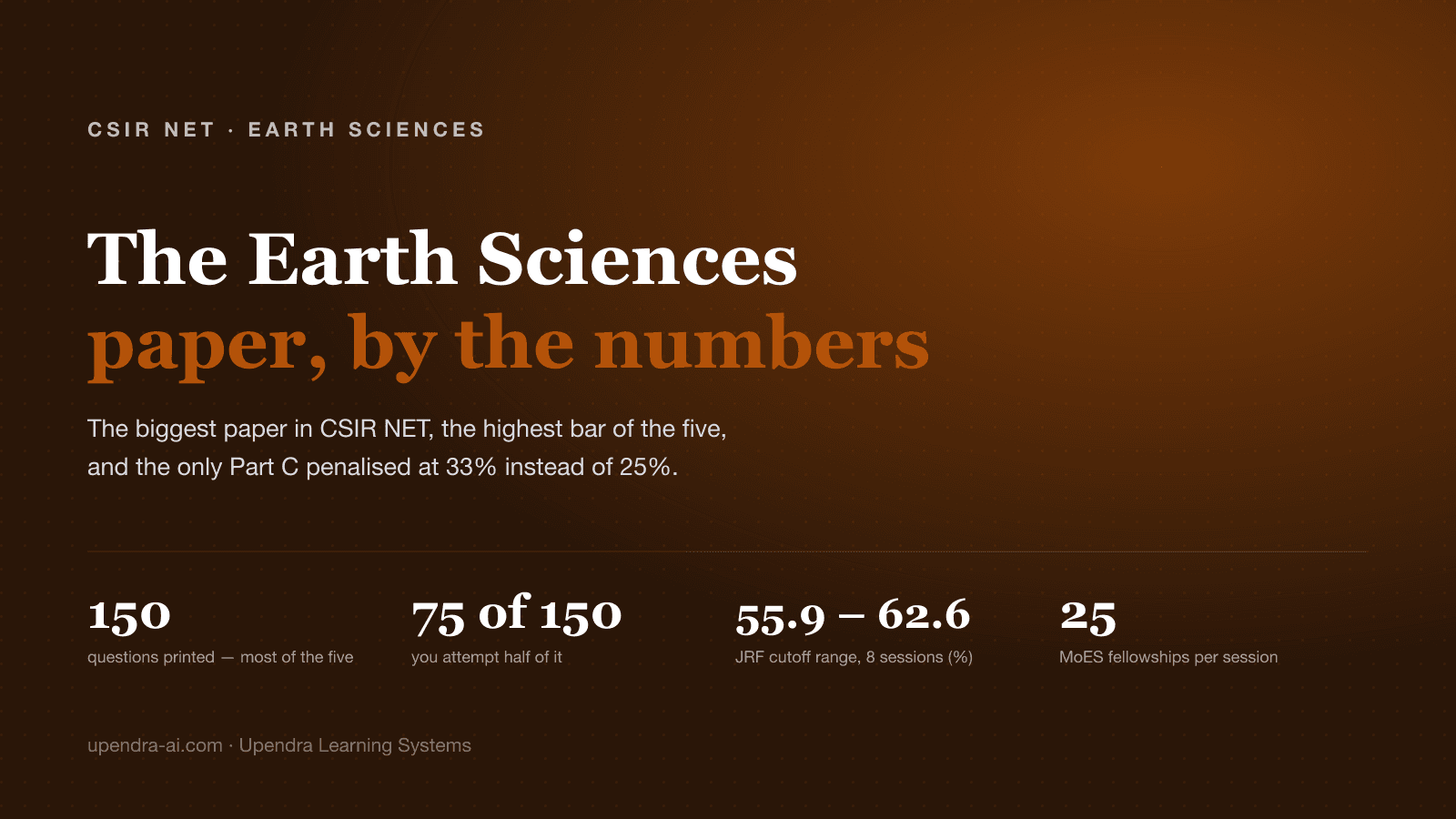
Earth, Atmospheric, Ocean and Planetary Sciences — subject code 702 — is the CSIR NET paper that most rewards knowing its structure before you sit it. Three facts set it apart from the other four subjects:
It prints 150 questions, more than any other paper, and lets you answer 75. Its Part C is penalised at 33% where every other subject uses 25%. And it has had the highest qualifying bar of the five subjects in six of the last eight sessions — while also being the steadiest, with a range of just 6.75 points.
This article covers the paper as it stands: how it is built and marked, how the syllabus splits into a common core and five streams, and what eight sessions of official cutoffs — both the June and the December cycles — actually say.
If you have not sat CSIR NET before, the general guide to the exam covers what applies to all five subjects — the three result categories, eligibility and what each grade of result gives you. This page assumes them.
Which year is this data from? The exam pattern, marking scheme, eligibility, fee and stipend are from the Joint CSIR-UGC NET June 2025 Information Bulletin published by the NTA. The cutoff series runs from June 2021 to December 2025, taken from the official cut-off notices on the CSIR-HRDG website.
December 2025 is the most recent session whose result has been declared — it came out on 23 February 2026. This page is updated after each session rather than replaced, so the older figures stay here beside the new ones.
1. How the paper is built
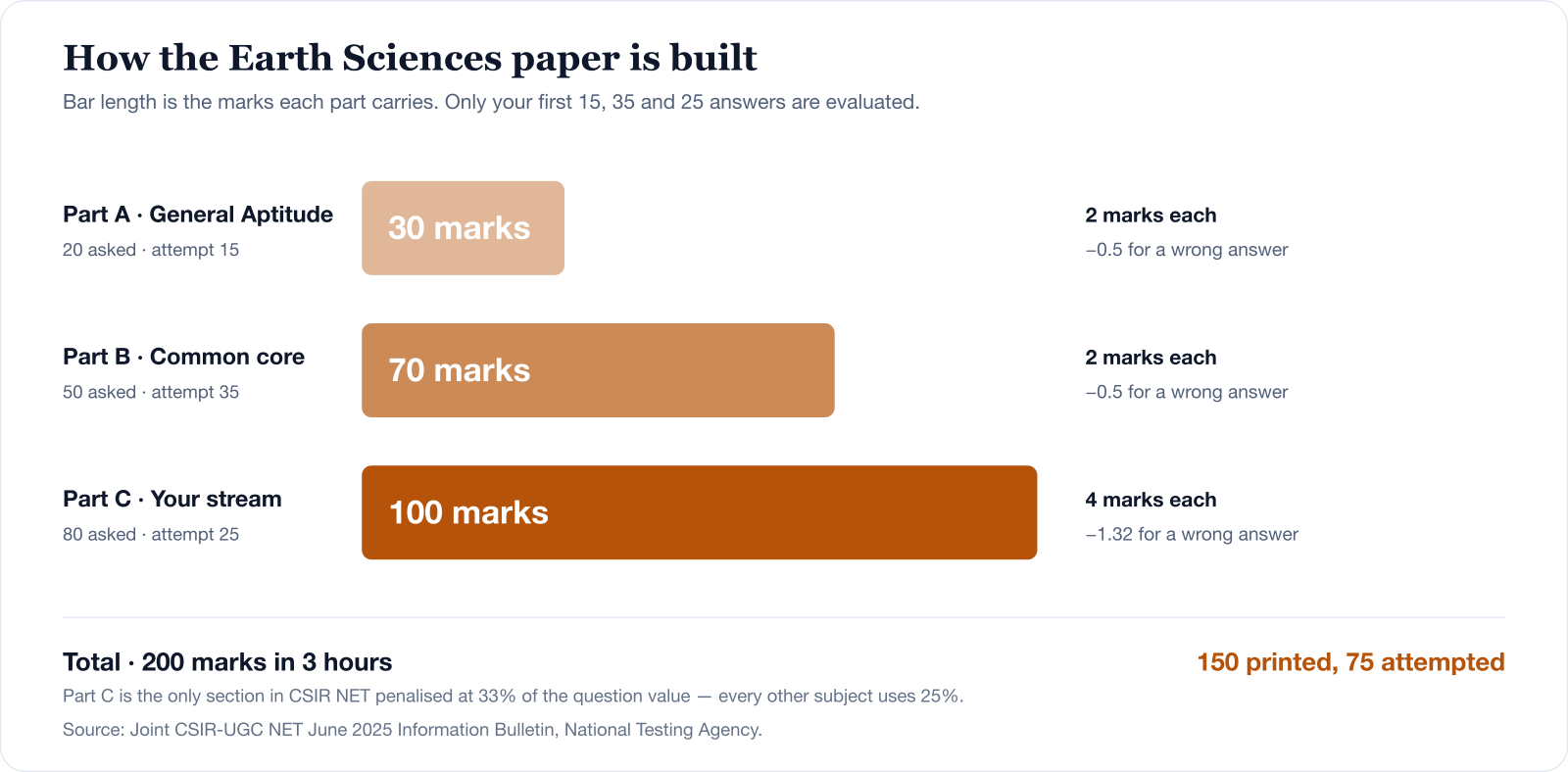
Three hours, 200 marks, three parts — and 150 questions printed, the largest paper in CSIR NET.
| Part | Asked | You attempt | Per question | Wrong answer | Marks |
| A — General Aptitude | 20 | 15 | +2 | −0.5 | 30 |
| B — Common core | 50 | 35 | +2 | −0.5 | 70 |
| C — Your stream | 80 | 25 | +4 | −1.32 | 100 |
| Total | 150 | 75 | 200 |
Every question in all three parts is a four-option multiple choice with exactly one correct answer.
That −1.32 is unique in CSIR NET. Every other subject penalises a wrong answer at 25% of the question’s value. Earth Sciences penalises Part A and Part B at 25% but Part C at 33%. On a 4-mark question that means getting it wrong instead of right swings 5.32 marks against you.
| Subject | Part C penalty rate | Swing on one Part C question |
| Earth Sciences | 33% | 5.32 marks |
| Chemical Sciences | 25% | 5.00 marks |
| Life Sciences | 25% | 5.00 marks |
| Physical Sciences | 25% | 6.25 marks |
| Mathematical Sciences | none | 4.75 marks |
The practical effect is that a coin-flip guess in Part C is worse value here than anywhere else in the exam. Eliminating two of four options gives you a 50% chance of +4 and a 50% chance of −1.32, which is still worth taking. Eliminating none gives you a 25% chance of +4 against a 75% chance of −1.32, which is not.
One rule to read carefully: only your first 15, 35 and 25 answers are evaluated. The bulletin is explicit that if you answer more than the limit in a part, only the first ones are taken up for marking. Answering thirty Part C questions does not give you a margin — it means the twenty-five that count are the first twenty-five you happened to answer.
2. Part B: the five topics everyone answers
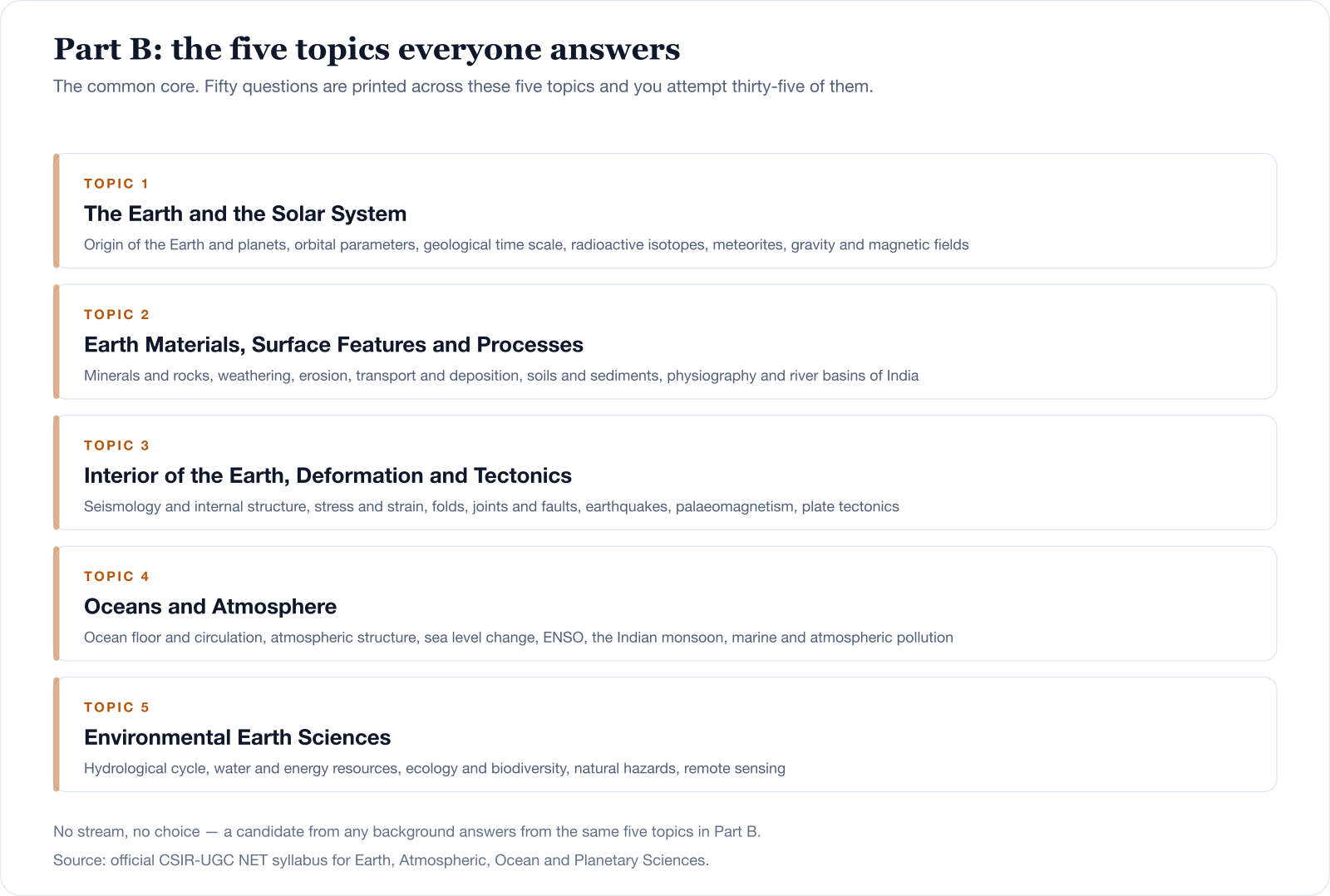
The syllabus is published in two halves, and CSIR labels them Paper I (Part B) and Paper I (Part C) — the same names as the sections of the question paper, which for once is not a coincidence. Part B has its own syllabus and Part C has a different one.
Part B is the common core: five broad topics that every candidate answers, whatever their background. Fifty questions are printed across them and you attempt thirty-five.
This is the part that catches out specialists. A geophysicist still answers questions on the Indian monsoon; a meteorologist still answers questions on folds, faults and plate tectonics. With only fifteen skips across fifty questions, there is no version of this paper in which you avoid the four topics that are not your own.
3. Part C: five streams, and you answer inside one

Part C is where the subject stops being one discipline. The syllabus divides it into five streams, and eighty questions are printed across all five while you answer twenty-five.
| Stream | What it covers |
| I. Geology | Mineralogy and petrology, structural geology and geotectonics, palaeontology, sedimentology and stratigraphy, marine geology and palaeoceanography, geochemistry, economic geology, Precambrian geology and crustal evolution, Quaternary geology, applied geology |
| II. Physical Geography | Geomorphology, climatology, biogeography, environmental geography, geography of India |
| III. Geophysics | Signal processing, field theory, numerical analysis and inversion, gravity and magnetic fields, plate tectonics and geodynamics, seismology, gravity and magnetic methods, electrical and electromagnetic methods, seismic methods, well logging |
| IV. Meteorology | Climatology, physical meteorology, atmospheric electricity, thermodynamics and dynamics, numerical weather prediction, general circulation, aviation and satellite meteorology |
| V. Ocean Sciences | Physical, chemical, geological and biological oceanography — water masses, waves and currents, sediments, marine ecology and productivity |
Twenty-five answers out of eighty printed is what makes the whole design work. There are enough questions in any one stream to fill your quota, so a geologist, a meteorologist and an oceanographer can sit the same paper, answer almost entirely different questions in Part C, and be ranked on one merit list. That is unusual: only Mathematical Sciences does anything similar, and it has two tracks rather than five.
Two of the streams overlap deliberately. Meteorology’s climatology sub-area is listed in the syllabus as “same as under Geography”, and marine geology appears both in the Geology stream and in Ocean Sciences. If your background sits between two streams, that overlap is worth mapping before you decide which questions to hunt for in the paper.
4. Eight sessions of cutoffs
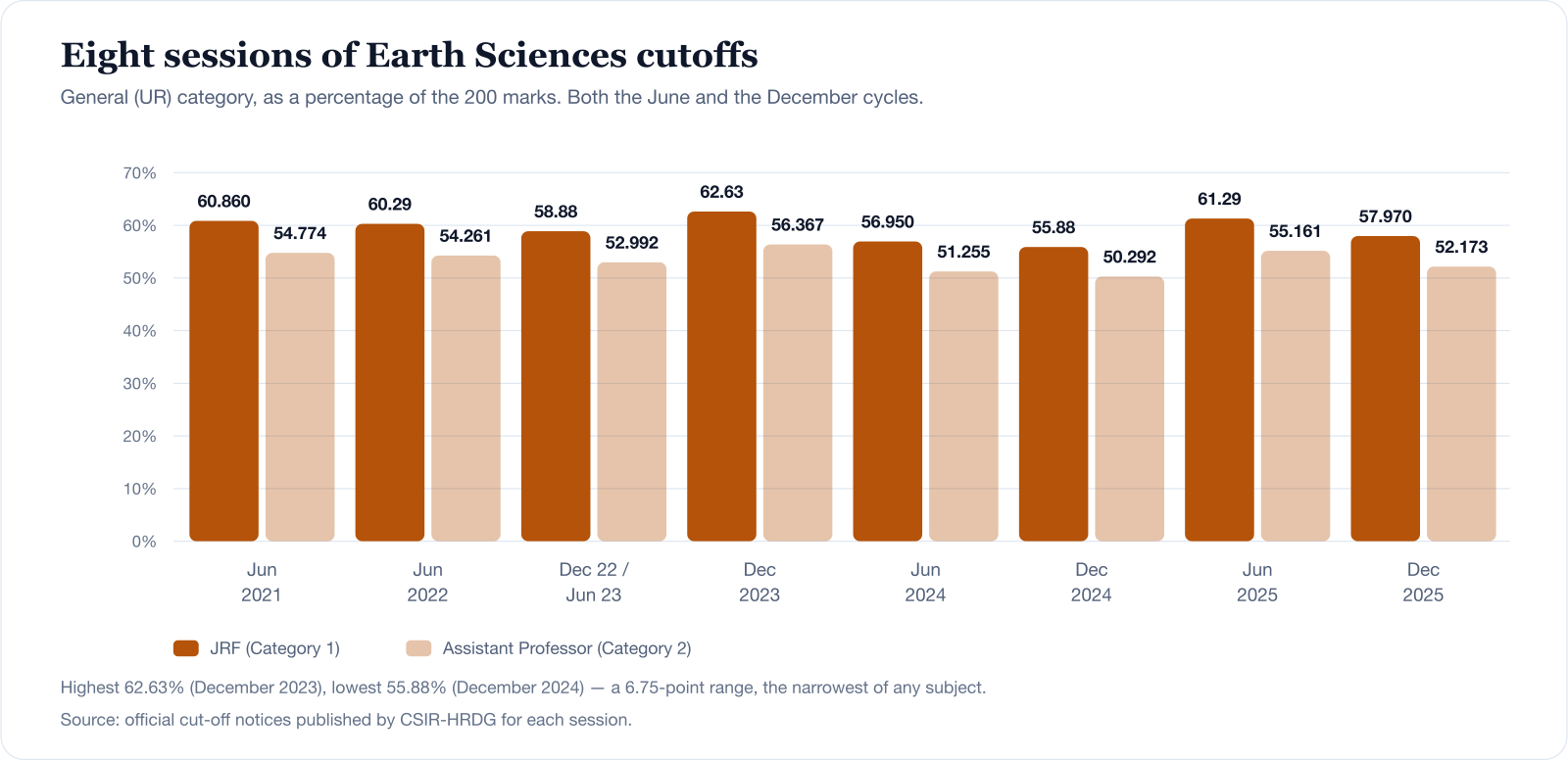
| Session | JRF (General) | Out of 200 | Asst. Professor (General) | PhD only (General) |
| June 2021 | 60.860% | 121.7 | 54.774% | — |
| June 2022 | 60.29% | 120.6 | 54.261% | — |
| Dec 2022 / June 2023 | 58.88% | 117.8 | 52.992% | — |
| December 2023 | 62.63% | 125.3 | 56.367% | — |
| June 2024 | 56.950% | 113.9 | 51.255% | not published |
| December 2024 | 55.88% | 111.8 | 50.292% | 41.83% |
| June 2025 | 61.29% | 122.6 | 55.161% | 45.310% |
| December 2025 | 57.970% | 115.9 | 52.173% | 42.900% |
Because the cutoff is a percentage of the same 200 marks each session, it converts straight into marks. The bar has ranged from 111.8 to 125.3 marks out of 200 — and it has never once fallen below 55%.
That is the highest floor of any CSIR NET subject. Mathematical Sciences has been as low as 42%, Physical Sciences as low as 38.8%. Earth Sciences has never been below 55.88%, and its whole eight-session range is 6.75 points where Mathematical Sciences spans 16.9.
This does not mean Earth Sciences is the hardest subject — it means the opposite of what most people read into it. The bar is set after the exam, from how the cohort actually scored. A consistently high cutoff says that a consistently high proportion of this subject’s candidates score well, which is what you would expect from a smaller, more specialised cohort. The five subjects are set, marked and cut off entirely separately, so a bar in one says nothing about another.
What it does mean practically is that there is very little slack in this subject. Around 115 marks out of 200 is what a General-category fellowship has cost in every recent session, and in a paper where a wrong Part C answer swings 5.32 marks, that total has to be built out of questions you actually know.
The three results, and the arithmetic that links them
You do not pass or fail CSIR NET. Your marks put you in one of three bands, each with its own published cutoff. Here are the two most recent sessions in full.
| December 2025 | UR | EWS | OBC | SC | ST | PwD |
| Category 1 — JRF | 57.970 | 52.310 | 50.110 | 40.990 | 40.900 | 25.000 |
| Category 2 — Asst. Professor | 52.173 | 47.079 | 45.099 | 36.891 | 36.810 | 25.000 |
| Category 3 — PhD only | 42.900 | 35.720 | 35.630 | 30.290 | 29.170 | 25.000 |
| June 2025 | UR | EWS | OBC | SC | ST | PwD |
| Category 1 — JRF | 61.29 | 53.97 | 53.13 | 44.99 | 43.38 | 26.70 |
| Category 2 — Asst. Professor | 55.161 | 48.573 | 47.817 | 40.491 | 39.042 | 25.000 |
| Category 3 — PhD only | 45.310 | 34.880 | 37.40 | 31.190 | 29.170 | 25.00 |
There is a rule hiding in those rows that CSIR does not state anywhere: the Assistant Professor cutoff is exactly 90% of the JRF cutoff, in every category and every session. 57.970 × 0.9 = 52.173. 61.29 × 0.9 = 55.161. It holds across all five subjects and all eight sessions above.
The one qualification is the floor. A minimum benchmark of 33% applies to General, EWS and OBC candidates and 25% to SC, ST and PwD candidates in all three categories. Where 90% of the JRF figure would fall below the floor, the floor is published instead — which is what happened to the PwD column in June 2025, where 90% of 26.70 is 24.03 and the published figure is 25.000.
The practical value is that you never need to wait for your category’s number. Take the General JRF figure, multiply by 0.9, and apply the floor.
What each result gives you, and the fellowship only this subject has
| Category 1 — JRF | A funded fellowship of ₹37,000 a month for the first two years, plus a ₹20,000 annual contingency grant. On registering for a PhD and clearing a review it rises to ₹42,000 from the third year. Also carries Assistant Professor eligibility and PhD admission. |
| Category 2 | Assistant Professor eligibility and PhD admission. No fellowship. |
| Category 3 | PhD admission only. |
Earth Sciences has a fourth route the other subjects do not. Alongside the CSIR and UGC fellowship lists, the result declares a separate list of Earth Science JRF (NET) MoES candidates — fellowships funded by the Ministry of Earth Sciences, governed by the same CSIR norms. There were exactly 25 of them in the June 2025 result and 25 again in December 2025. It is a small list, but it exists only for this subject, and it is awarded from the same merit list rather than by a separate application.
Category 3 is much the largest of the three bands. In the December 2025 session — across all five subjects — 8,035 candidates qualified for PhD admission only, 2,941 for Category 2, and about 3,370 for a fellowship. In June 2025 the same figures were 9,232, 2,886 and roughly 2,890.
5. Shifts, and why they do not change your cutoff
Earth Sciences has been split across two shifts more than once. In the December 2024 session it was examined on 28 February 2025 and again on 2 March 2025 — two entirely different papers, with two separate answer keys published by the NTA. In June 2024 it ran on 25 July 2024, in June 2025 on 28 July 2025 (Shift 1), and in December 2025 on 18 December 2025.
Even with two different papers, only one cutoff is published for the subject: 55.88% for General JRF in December 2024. The bulletin explains how. When a subject runs in multiple shifts, raw marks are converted to percentile scores, the shifts are merged, and if the percentiles come out unequal then “the lowest will be the eligibility cut-off for that category for all candidates”. The rule is deliberately generous — it protects whichever shift got the harder paper rather than averaging the two.
So there is nothing to plan for. You cannot choose your shift, a harder shift is not a disadvantage you have to make up, and there is no separate “shift 1 cutoff” to look for — only one number per subject, per category, per session.
One more rule from every cut-off notice CSIR publishes: there is no separate cutoff for Part A, B or C. Only the cumulative total decides the merit list. You do not have to clear a bar in each part — which matters here, because a candidate can be strong in one stream and merely competent in the common core and still qualify.
6. Who may sit it
| Rule | What it says |
| Qualifying degree | A Master’s degree with at least 55% marks — 50% for OBC-NCL, SC, ST, PwD and third-gender candidates. Final-year students may apply and are admitted provisionally. |
| Four-year bachelor’s degree | Eligible with 75% in aggregate (relaxed by 5% for reserved categories). Such candidates can qualify for JRF and PhD admission, but not for Assistant Professor. |
| Age — for JRF | Not more than 30 years as on the first day of the month in which the exam concludes, with up to 5 years’ relaxation for OBC-NCL, SC, ST, PwD, third-gender and women candidates, and for research or armed-forces experience. |
| Age — for Assistant Professor and PhD | No upper age limit at all. |
| Attempts | No limit. Held twice a year. |
| Application fee | ₹1,150 General · ₹600 EWS and OBC-NCL · ₹325 SC, ST, PwD and third gender. |
The age rule is the one most often reported wrong. The limit exists for the fellowship, not for the exam. A candidate past 30 can sit the paper, qualify, and be certified for Assistant Professor and for PhD admission — they simply cannot be awarded the JRF.
7. What this paper is actually asking for
- Prepare the common core as seriously as your own stream. Part B is 70 marks, it is 35 answers out of 50, and four of its five topics will be outside your specialisation whoever you are.
- Pick your Part C stream before the exam, not during it. Eighty questions are printed and only your first 25 answers count. Knowing which stream you are hunting for turns a 150-question paper into a manageable one.
- Respect the 33% penalty. This is the only section in CSIR NET penalised at a third rather than a quarter. Guess only when you have genuinely eliminated two options.
- Expect a high bar. The General-category fellowship cutoff has not dropped below 111.8 marks out of 200 in eight sessions. Aim at a total, not at clearing a threshold.
- Map your stream overlaps. Climatology sits in both Meteorology and Physical Geography; marine geology sits in both Geology and Ocean Sciences. Those doubled areas are the cheapest extra questions available to you.
- Do not ignore Part A. Thirty marks of general aptitude, no earth science in it at all, identical for every subject — and the cheapest marks in the paper for anyone willing to practise them.
The syllabus is public and every candidate has the same one. In this subject, what separates results is a common core you cannot specialise your way out of, and a Part C stream you should have chosen long before you opened the paper.
Quick answers
Frequently asked
Why is the negative marking different in CSIR NET Earth Sciences?
Part A and Part B are penalised at 25% of the question's value like every other subject, but Part C is penalised at 33% — a wrong 4-mark answer costs 1.32 marks. Earth Sciences is the only CSIR NET subject with a 33% Part C penalty, so getting one Part C question wrong instead of right swings 5.32 marks against you.
What was the CSIR NET Earth Sciences cutoff in December 2025?
For the General category, 57.970% for JRF (Category 1), 52.173% for Assistant Professor (Category 2) and 42.900% for PhD admission only (Category 3). Since the cutoff is a percentage of 200 marks, the JRF figure works out at 115.94 marks.
Why is the Earth Sciences cutoff always the highest?
It has been the highest of the five subjects in six of the last eight sessions and has never fallen below 55.88%. That does not mean the subject is harder — the bar is set after the exam from how the cohort actually scored, so a consistently high cutoff means a consistently high proportion of this subject's candidates score well. The five subjects are set, marked and cut off separately, so their cutoffs cannot be compared.
Do I have to answer questions outside my specialisation?
In Part B, yes. The common core is five topics — the Earth and solar system, earth materials and surface processes, the Earth's interior and tectonics, oceans and atmosphere, and environmental earth sciences — and you answer 35 of the 50 questions printed across them, whatever your background. Part C is where you stay inside your own stream.
What are the five streams in CSIR NET Earth Sciences Part C?
Geology, Physical Geography, Geophysics, Meteorology and Ocean Sciences. Eighty questions are printed across all five and you attempt 25, which is enough to answer entirely within one stream.
What is the MoES fellowship in CSIR NET?
A separate list of Junior Research Fellowships funded by the Ministry of Earth Sciences, declared alongside the CSIR and UGC lists and governed by the same CSIR fellowship norms. It exists only for Earth Sciences and is awarded from the same merit list — there is no separate application. There were 25 MoES fellowships in the June 2025 result and 25 again in December 2025.
How are the category cutoffs for CSIR NET decided?
The Assistant Professor cutoff is exactly 90% of the JRF cutoff in the same category, subject to a floor: a minimum benchmark of 33% for General, EWS and OBC candidates and 25% for SC, ST and PwD candidates. Where 90% would fall below the floor, the floor is published instead — as happened to the PwD column in June 2025.
Do I need to clear a separate cutoff in Part A, B and C?
No. Every CSIR cut-off notice states it explicitly: there is no separate cutoff for Part A, B or C. Only the cumulative total across all three parts is used to draw the merit list.
How much is the CSIR NET JRF stipend?
₹37,000 a month for the first two years, plus a contingency grant of ₹20,000 a year. On registering for a PhD and clearing an assessment it rises to ₹42,000 a month from the third year. MoES-funded fellows are governed by the same norms.
Is there an age limit for CSIR NET Earth Sciences?
Only for the fellowship. JRF has an upper age limit of 30 years as on the first day of the month in which the exam concludes, relaxed by up to five years for OBC-NCL, SC, ST, PwD and third-gender candidates, for women, and for research or armed-forces experience. There is no upper age limit at all for Assistant Professor eligibility or for PhD admission.
Tagged
Keep reading