
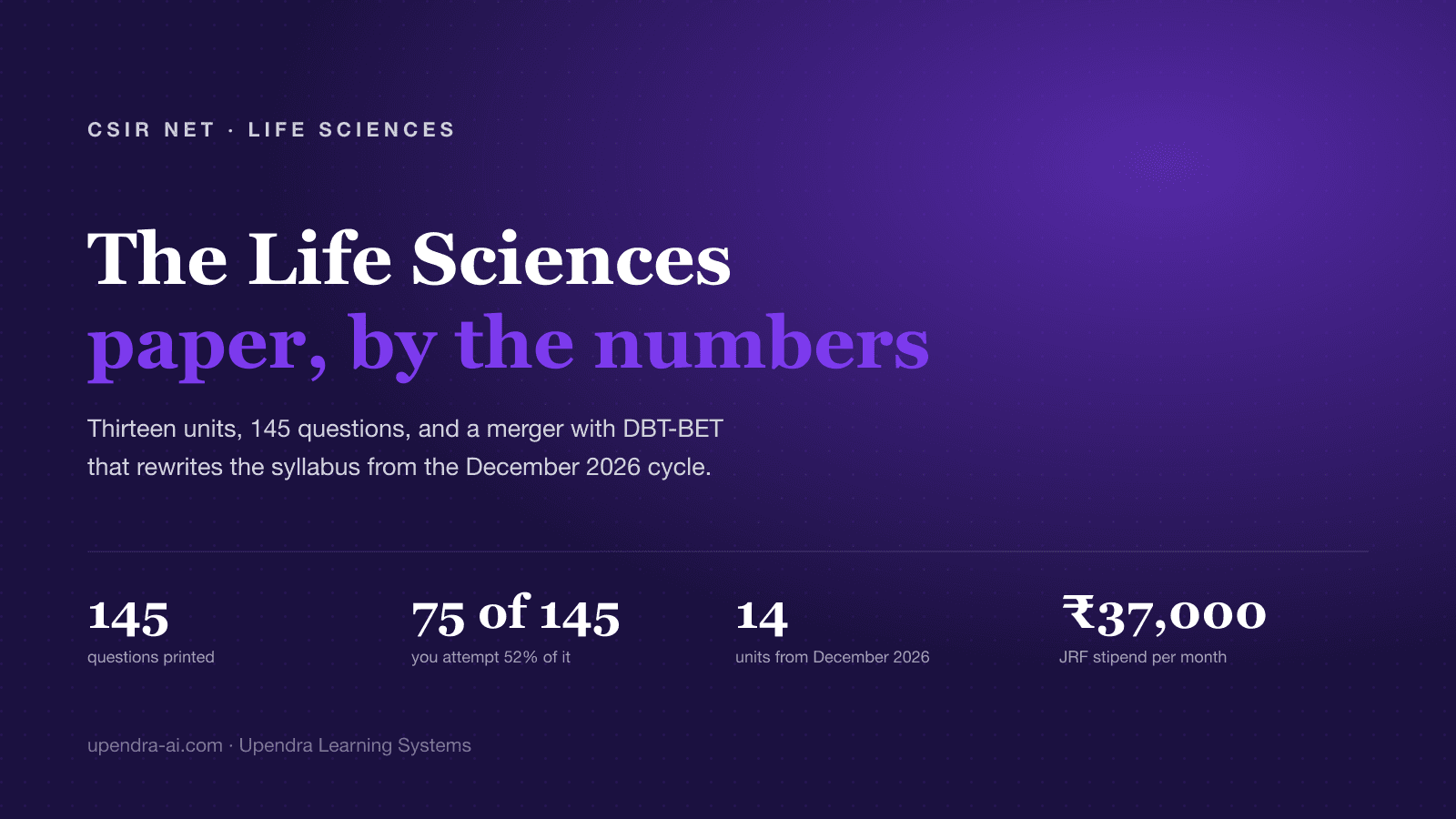
Life Sciences is the CSIR NET paper with the most candidates, the broadest syllabus and, right now, the most change. Two things about it are not true of any other subject:
Its cutoffs were published as an NTA percentile rather than as marks in every session from June 2021 to December 2024 — which is why you will find people quoting a “99.03 cutoff” for a 200-mark paper. And from the December 2026 cycle it stops being CSIR NET Life Sciences altogether: it merges with DBT-BET to become the Joint CSIR–UGC–DBT JRF-NET, with a new fourteen-unit syllabus that has already been published.
This article covers both: the paper as it stands, and what changes.
If you have not sat CSIR NET before, the general guide to the exam covers what applies to all five subjects — the three result categories, eligibility and what each grade of result gives you. This page assumes them.
Which year is this data from? The exam pattern, marking scheme, eligibility, fee and stipend are from the Joint CSIR-UGC NET June 2025 Information Bulletin published by the NTA. The cutoff series runs from June 2021 to December 2025, from the official cut-off notices on the CSIR-HRDG website. The merger details are from the CSIR-HRDG notice of 13 January 2026 and the merged syllabus published on 21 January 2026.
December 2025 is the most recent session whose result has been declared — it came out on 23 February 2026. This page is updated after each session rather than replaced.
1. How the paper is built
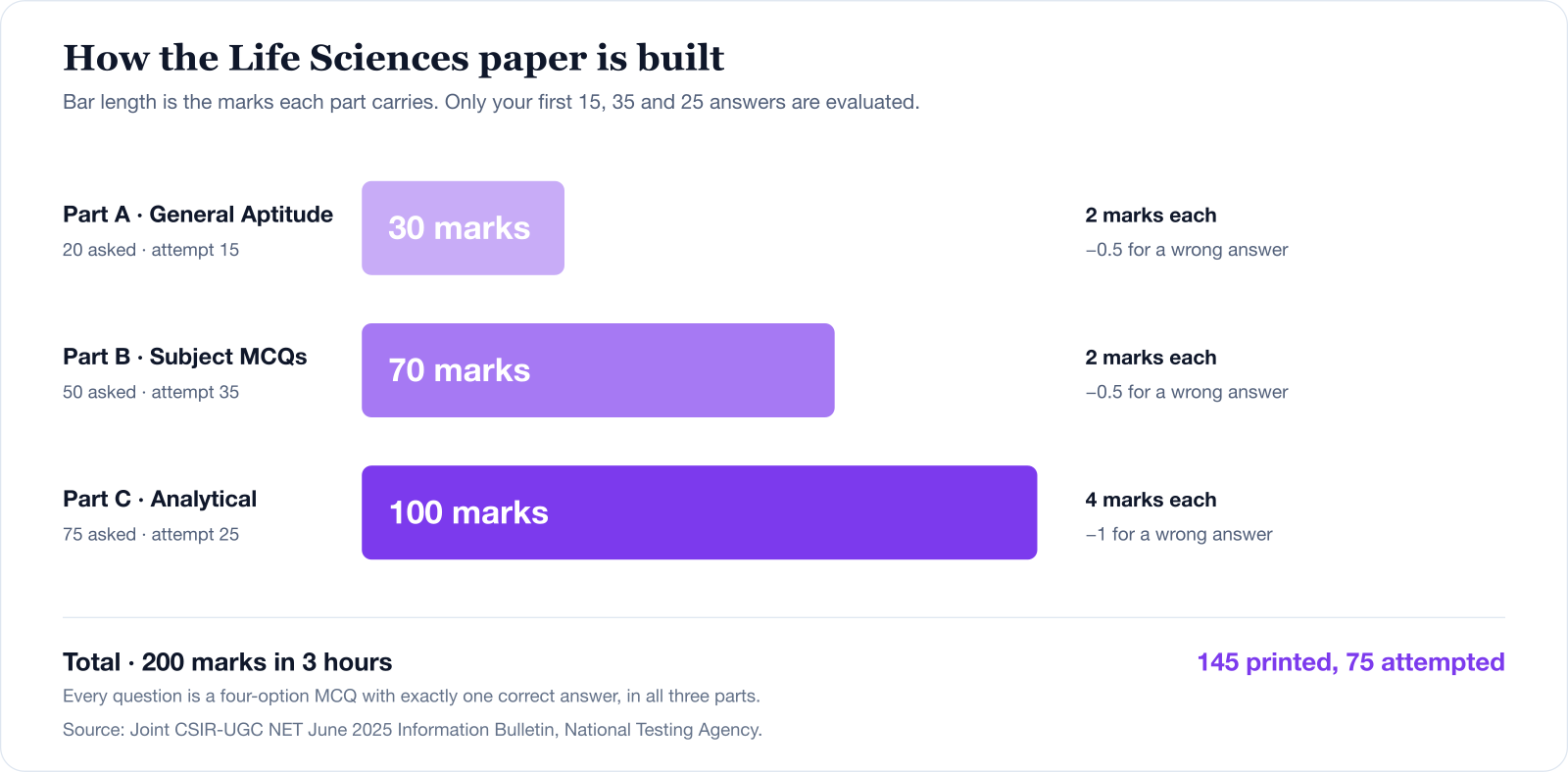
Three hours, 200 marks, three parts — and 145 questions printed, the second-largest paper in CSIR NET after Earth Sciences.
| Part | Asked | You attempt | Per question | Wrong answer | Marks |
| A — General Aptitude | 20 | 15 | +2 | −0.5 | 30 |
| B — Subject MCQs | 50 | 35 | +2 | −0.5 | 70 |
| C — Analytical | 75 | 25 | +4 | −1 | 100 |
| Total | 145 | 75 | 200 |
Every question in all three parts is a four-option multiple choice with exactly one correct answer, and every part is penalised at 25% of the question’s value.
Seventy-five Part C questions are printed and you answer twenty-five. That is the widest choice in Part C of any CSIR NET subject, and it is worth 100 marks. Fifty questions get left behind, so which twenty-five you pick is a larger decision here than anywhere else in the exam — and the read-through that lets you pick well is not wasted time.
One rule to read carefully: only your first 15, 35 and 25 answers are evaluated. The bulletin is explicit that if you answer more than the limit in a part, only the first ones are taken up for marking. Answering thirty Part C questions does not give you a margin — it means the twenty-five that count are the first twenty-five you happened to answer.
2. Thirteen units, none of them optional
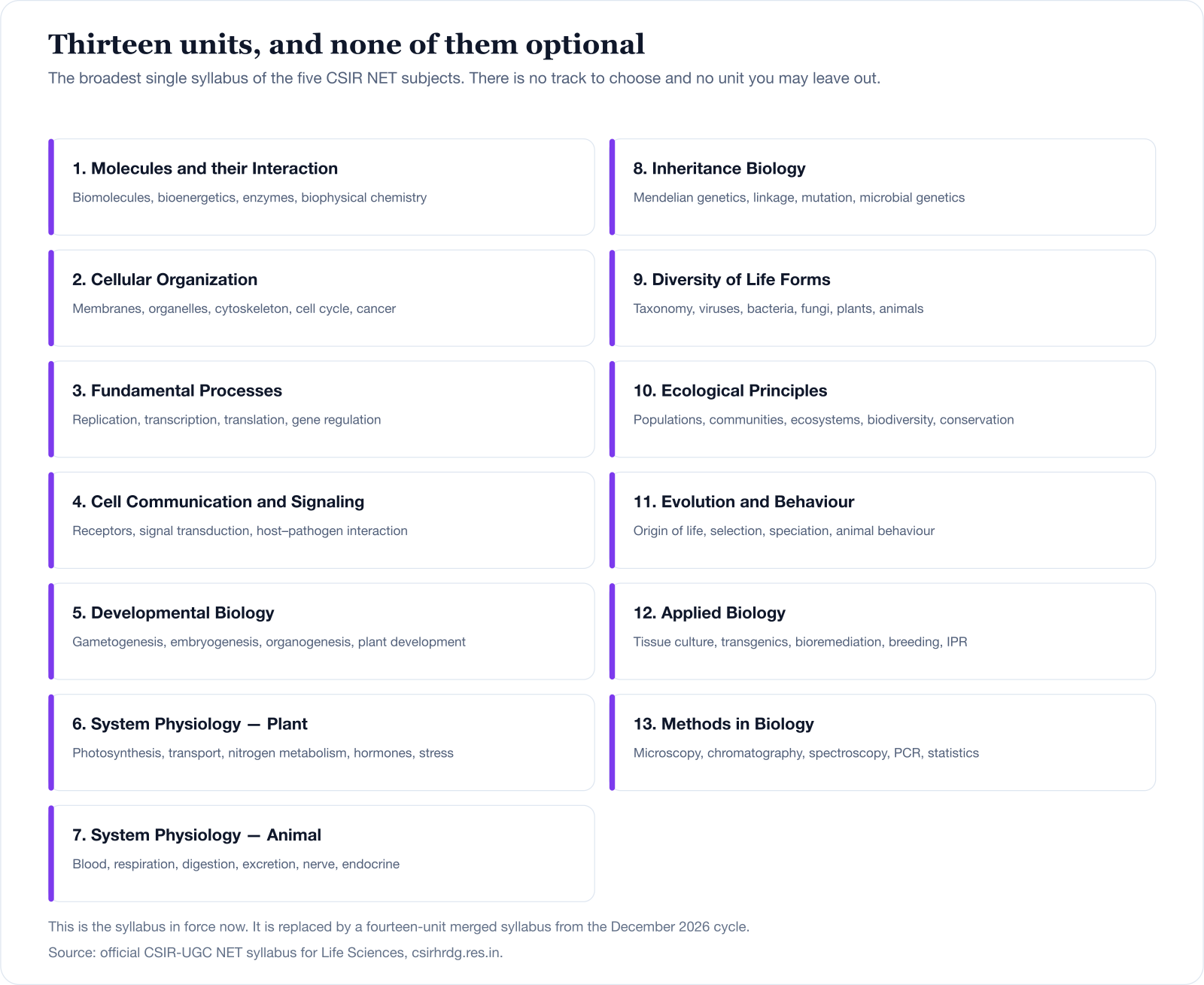
This is the broadest single syllabus of the five subjects, and unlike Mathematical Sciences (a mathematics track and a statistics track) or Earth Sciences (five streams in Part C), it offers no choice of specialisation. Thirteen units, all of them examinable, from biophysical chemistry to animal behaviour.
Two units repay attention out of proportion to their length. Unit 13, Methods in Biology, is the only unit whose content appears inside questions from every other unit — microscopy, chromatography, electrophoresis, PCR, blotting, and the statistics used to interpret them. And Unit 3, Fundamental Processes, is the one most Part C questions are built on top of, because replication, transcription, translation and gene regulation are what an analytical question in this subject usually asks you to reason about.
3. Percentile or marks: the cutoff that changed shape
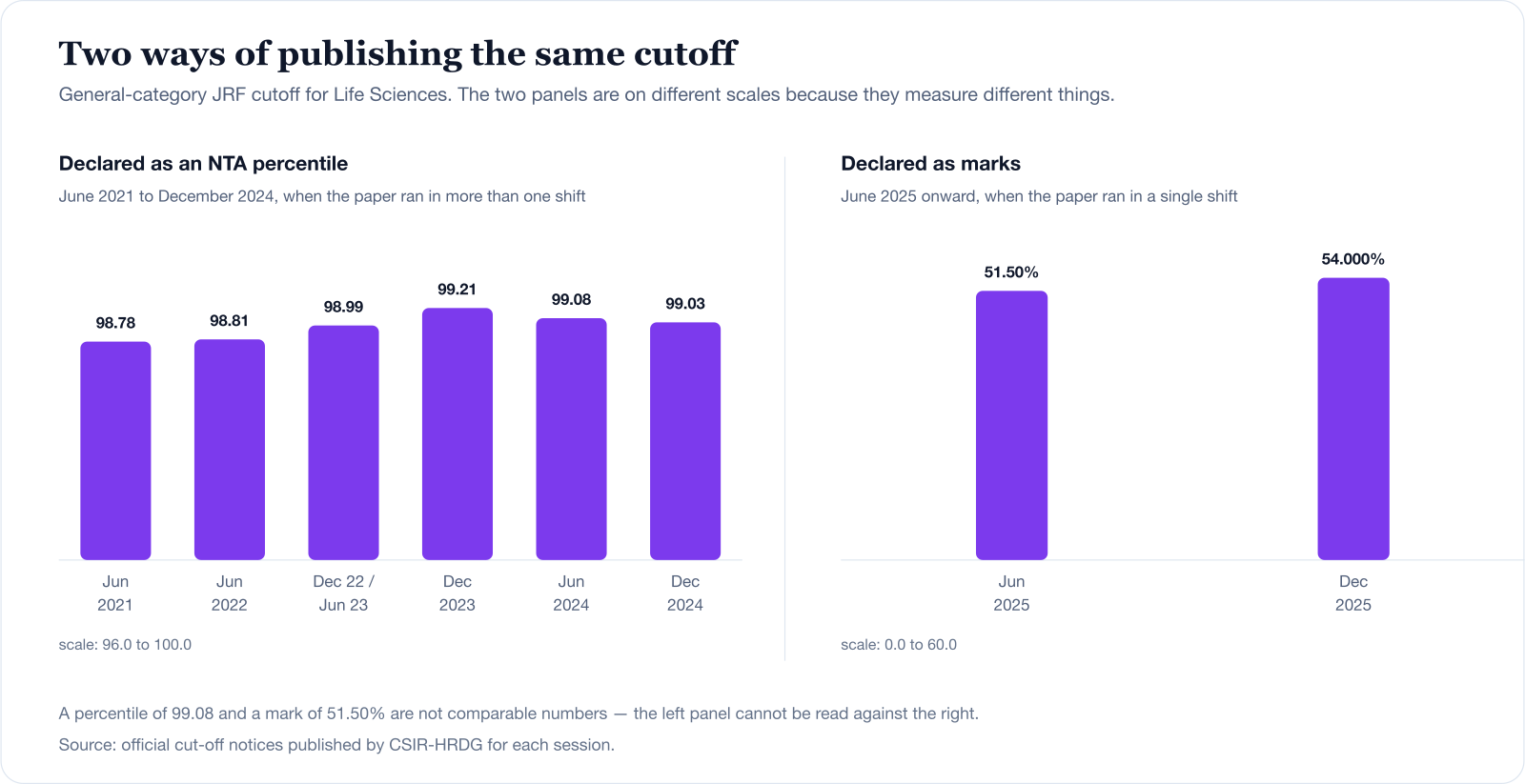
This is the single biggest source of confusion about the Life Sciences cutoff, and it has a straightforward explanation.
Every cut-off notice from June 2021 to December 2024 carries a footnote against Life Sciences: “In Life Science subject, the raw marks obtained have been normalized into NTA score/percentile and results have been declared based on percentile cutoff as indicated.” No other subject carried that note. So the published Life Sciences figure in those sessions was a percentile, not a mark: 99.0846682 in June 2024 does not mean 99% of the paper — it means the candidate at the bar scored better than about 99% of the cohort.
From June 2025 the footnote is gone, and the figures are plain percentages of 200 marks like every other subject: 51.50% in June 2025 and 54.000% in December 2025, which are 103 and 108 marks.
Why the change? Normalisation is what the NTA does when a subject runs in more than one shift, and Life Sciences did. The answer keys show it sat two papers on 26 July 2024 and two more on 1 March 2025. In June 2025 and December 2025 it ran in a single shift — one paper for everyone — and single-shift papers do not need normalising. That is exactly when percentile reporting stopped.
| Session | JRF (General) | Published as | Asst. Professor (General) |
| June 2021 | 98.7860248 | Percentile | 97.0117533 |
| June 2022 | 98.8142819 | Percentile | 97.5053291 |
| Dec 2022 / June 2023 | 98.9915884 | Percentile | 97.3904275 |
| December 2023 | 99.2136117 | Percentile | 98.0541384 |
| June 2024 | 99.0846682 | Percentile | 98.3439721 |
| December 2024 | 99.0315191 | Percentile | 97.9238847 |
| June 2025 | 51.50% | Marks — 103 of 200 | 46.350% |
| December 2025 | 54.000% | Marks — 108 of 200 | 48.600% |
The practical consequence: do not compare a percentile session with a marks session. They are different quantities. If you want a target in marks, the only two sessions that give you one are June 2025 and December 2025, and they say roughly 103–108 out of 200 for a General-category fellowship.
One more thing the two kinds of session do differently. In every marks-based session, across all five subjects, the Assistant Professor cutoff is exactly 90% of the JRF cutoff — 54.000 × 0.9 = 48.600, 51.50 × 0.9 = 46.350 — subject to a floor of 33% for General, EWS and OBC candidates and 25% for SC, ST and PwD. In the percentile sessions that ratio does not appear, because a percentile is not a linear scale: 90% of the marks does not map to 90% of the percentile.
The three results, and the two most recent sessions in full
| December 2025 | UR | EWS | OBC | SC | ST | PwD |
| Category 1 — JRF | 54.000 | 44.000 | 44.250 | 36.000 | 34.250 | 25.000 |
| Category 2 — Asst. Professor | 48.600 | 39.600 | 39.825 | 32.400 | 30.825 | 25.000 |
| Category 3 — PhD only | 39.000 | 33.000 | 33.000 | 25.000 | 25.000 | 25.000 |
| June 2025 | UR | EWS | OBC | SC | ST | PwD |
| Category 1 — JRF | 51.50 | 44.00 | 43.75 | 37.25 | 35.75 | 25.00 |
| Category 2 — Asst. Professor | 46.350 | 39.60 | 39.375 | 33.525 | 32.175 | 25.000 |
| Category 3 — PhD only | 38.25 | 33.00 | 33.00 | 27.50 | 25.75 | 25.00 |
| Category 1 — JRF | A funded fellowship of ₹37,000 a month for the first two years, plus a ₹20,000 annual contingency grant. On registering for a PhD and clearing a review it rises to ₹42,000 from the third year. Also carries Assistant Professor eligibility and PhD admission. |
| Category 2 | Assistant Professor eligibility and PhD admission. No fellowship. |
| Category 3 | PhD admission only. |
Category 3 is much the largest. In the December 2025 session — across all five subjects — 8,035 candidates qualified for PhD admission only, 2,941 for Category 2, and about 3,370 for a fellowship. In June 2025 the same figures were 9,232, 2,886 and roughly 2,890.
4. December 2026: the merger with DBT-BET

On 13 January 2026 CSIR-HRDG published a notice confirming that CSIR-NET (Life Sciences) and DBT-BET (Biotechnology) will merge into a single Joint CSIR–UGC–DBT JRF-NET, from the December 2026 examination cycle. The merged syllabus — “Life Sciences and Biotechnology” — was published on 21 January 2026. It has fourteen units where the current one has thirteen.
| What happens | Which units |
| Carry over | Cellular Organization; Fundamental Processes; Cell Communication and Cell Signaling; Developmental Biology; System Physiology — Plant; System Physiology — Animal; Inheritance Biology; Methods in Biology |
| Renamed | “Molecules and their Interaction Relevant to Biology” becomes “Structure and Function of Biomolecules” |
| Recombined | Diversity of Life Forms, Ecological Principles and Evolution and Behaviour become two units: “Evolution and Diversity of Life Forms” and “Ecology and Behavioural Biology” |
| New | Bioinformatics and Computational Biology · Biochemical Engineering and Industrial Biotechnology · Advances in Biotechnology |
| Replaced | “Applied Biology” disappears as a unit; its material is absorbed into the three new biotechnology units |
CSIR’s notice records the three concerns candidates raised and answers each of them directly:
- Will there be fewer fellowships? No. The notice states plainly that there will be “no impact on the total number of fellowships” — CSIR and DBT will each continue to fund as before, and only the selection exam becomes common.
- Will a life sciences candidate be forced into biotechnology questions? The paper is to carry “adequate optional questions covering both traditional Life Sciences and Biotechnology domains”, so candidates from either background can attempt enough questions in their own area. That matters in a paper where you already answer only 25 of 75 in Part C.
- Will biotechnology candidates face more competition? They also gain something they did not have: the notice confirms that qualified biotechnology candidates will now be eligible for all three categories — JRF, Assistant Professor and PhD admission — which was not the case under DBT-BET.
What this means if you are preparing now. Sessions up to and including June 2026 use the thirteen-unit Life Sciences syllabus. The change begins with the December 2026 cycle. If your target is December 2026 or later, the merged syllabus is already published and the three new units are real additional content — not a renaming exercise.
5. Shifts, and why they do not change your cutoff
Life Sciences is the subject most often split across shifts, which is why the percentile question arose here and nowhere else.
| Session | When it was held | Shifts for Life Sciences |
| June 2024 | 26 July 2024 | Two — First and Second |
| December 2024 | 1 March 2025 | Two — Shift 1 and Shift 2 |
| June 2025 | 28 July 2025 | One (Shift 1) |
| December 2025 | 18 December 2025 | One |
Even with two entirely different papers, only one cutoff is published for the subject. The bulletin explains how: raw marks are converted to percentile scores, the shifts are merged, and if the percentiles come out unequal then “the lowest will be the eligibility cut-off for that category for all candidates”. The rule is deliberately generous — it protects whichever shift got the harder paper rather than averaging the two.
So there is nothing to plan for. You cannot choose your shift, a harder shift is not a disadvantage you have to make up, and there is no separate “shift 1 cutoff” to look for.
One more rule from every cut-off notice CSIR publishes: there is no separate cutoff for Part A, B or C. Only the cumulative total decides the merit list.
6. Who may sit it
| Rule | What it says |
| Qualifying degree | A Master’s degree with at least 55% marks — 50% for OBC-NCL, SC, ST, PwD and third-gender candidates. Final-year students may apply and are admitted provisionally. |
| Four-year bachelor’s degree | Eligible with 75% in aggregate (relaxed by 5% for reserved categories). Such candidates can qualify for JRF and PhD admission, but not for Assistant Professor. |
| Age — for JRF | Not more than 30 years as on the first day of the month in which the exam concludes, with up to 5 years’ relaxation for OBC-NCL, SC, ST, PwD, third-gender and women candidates, and for research or armed-forces experience. |
| Age — for Assistant Professor and PhD | No upper age limit at all. |
| Attempts | No limit. Held twice a year. |
| Application fee | ₹1,150 General · ₹600 EWS and OBC-NCL · ₹325 SC, ST, PwD and third gender. |
The age rule is the one most often reported wrong. The limit exists for the fellowship, not for the exam. A candidate past 30 can sit the paper, qualify, and be certified for Assistant Professor and for PhD admission — they simply cannot be awarded the JRF.
7. What this paper is actually asking for
- Coverage, first and last. Thirteen units with no optional track, and 35 of 50 Part B questions to answer, means a unit you never studied properly will find you.
- Choose your 25 Part C questions deliberately. Seventy-five are printed and only your first 25 answers count. This is the widest choice in the exam and the easiest to waste.
- Learn the methods unit properly. It is the only unit whose content turns up inside questions from every other unit.
- Guess carefully. Every part is penalised at 25%; a wrong Part C answer swings 5 marks against you once you count the 4 you did not get.
- Use a marks target, not a percentile. The only two sessions published in marks put a General-category fellowship at roughly 103–108 out of 200. Percentile figures from earlier sessions are not comparable.
- If you are aiming at December 2026 or later, prepare the merged syllabus. Three genuinely new biotechnology units are already published.
- Do not ignore Part A. Thirty marks of general aptitude, no biology in it at all — and the cheapest marks in the paper for anyone willing to practise them.
The syllabus is public and every candidate has the same one. In this subject, more than any other, what separates results is breadth you cannot fake and a Part C selection you have to make well in the room.
Quick answers
Frequently asked
Why is the CSIR NET Life Sciences cutoff shown as 99 percent?
Because in those sessions it was not a mark — it was an NTA percentile. Every cut-off notice from June 2021 to December 2024 carried a footnote saying Life Sciences raw marks were normalised into a percentile. A figure of 99.08 means the candidate at the bar scored better than about 99% of the cohort, not that they scored 99% of the paper.
What was the CSIR NET Life Sciences cutoff in December 2025?
For the General category, 54.000% for JRF (Category 1), 48.600% for Assistant Professor (Category 2) and 39.000% for PhD admission only (Category 3). Since the cutoff is a percentage of 200 marks, the JRF figure works out at 108 marks. June 2025 was 51.50%, which is 103 marks.
Why did CSIR stop publishing the Life Sciences cutoff as a percentile?
Normalisation is used when a subject runs in more than one shift, and Life Sciences did — two papers on 26 July 2024 and two more on 1 March 2025. In June 2025 and December 2025 it ran in a single shift, so there was nothing to normalise, and the cutoffs were published as plain percentages of marks like every other subject.
Is CSIR NET Life Sciences merging with DBT-BET?
Yes. A CSIR-HRDG notice dated 13 January 2026 confirms that CSIR-NET (Life Sciences) and DBT-BET (Biotechnology) merge into a single Joint CSIR–UGC–DBT JRF-NET from the December 2026 examination cycle. The merged Life Sciences and Biotechnology syllabus was published on 21 January 2026 and has fourteen units.
What is new in the merged CSIR-UGC-DBT syllabus?
Three genuinely new units: Bioinformatics and Computational Biology; Biochemical Engineering and Industrial Biotechnology; and Advances in Biotechnology. Eight units carry over unchanged, one is renamed, and three of the old units are recombined into two. The old Applied Biology unit disappears, absorbed into the new biotechnology units.
Will the merger reduce the number of fellowships?
CSIR's notice says no. It states that there will be no impact on the total number of fellowships — CSIR and DBT will each continue to fund as before, and only the selection exam becomes common. It also confirms that qualified biotechnology candidates will now be eligible for all three categories, which was not the case under DBT-BET.
How many questions are there in CSIR NET Life Sciences?
One hundred and forty-five are printed — 20 in Part A, 50 in Part B and 75 in Part C — and you attempt 75 of them: 15, 35 and 25. The 75 printed Part C questions give the widest choice in Part C of any CSIR NET subject.
Is there negative marking in CSIR NET Life Sciences?
Yes, in all three parts, at 25% of the question's value. A wrong answer costs 0.5 in Part A, 0.5 in Part B and 1 mark in Part C. Because a Part C question is worth 4 marks, getting one wrong instead of right swings 5 marks against you.
How much is the CSIR NET JRF stipend?
₹37,000 a month for the first two years, plus a contingency grant of ₹20,000 a year. On registering for a PhD and clearing an assessment it rises to ₹42,000 a month from the third year.
Is there an age limit for CSIR NET Life Sciences?
Only for the fellowship. JRF has an upper age limit of 30 years as on the first day of the month in which the exam concludes, relaxed by up to five years for OBC-NCL, SC, ST, PwD and third-gender candidates, for women, and for research or armed-forces experience. There is no upper age limit at all for Assistant Professor eligibility or for PhD admission.
Tagged
Keep reading