
IIT JAM — the Joint Admission Test for Masters — is how you get into a postgraduate science programme at an IIT, at IISc, and at a long list of NITs and other centrally funded institutes. It is written by final-year undergraduates and by graduates who decided later, and it is the single most direct route from a BSc to an MSc at those institutions.
This is the general guide: what the exam is, how the paper is built, how it is marked, who may sit it, and what a rank actually gets you. Paper-by-paper syllabus and subject strategy are separate articles — this one is the map.
1. Seven papers, and you pick your own
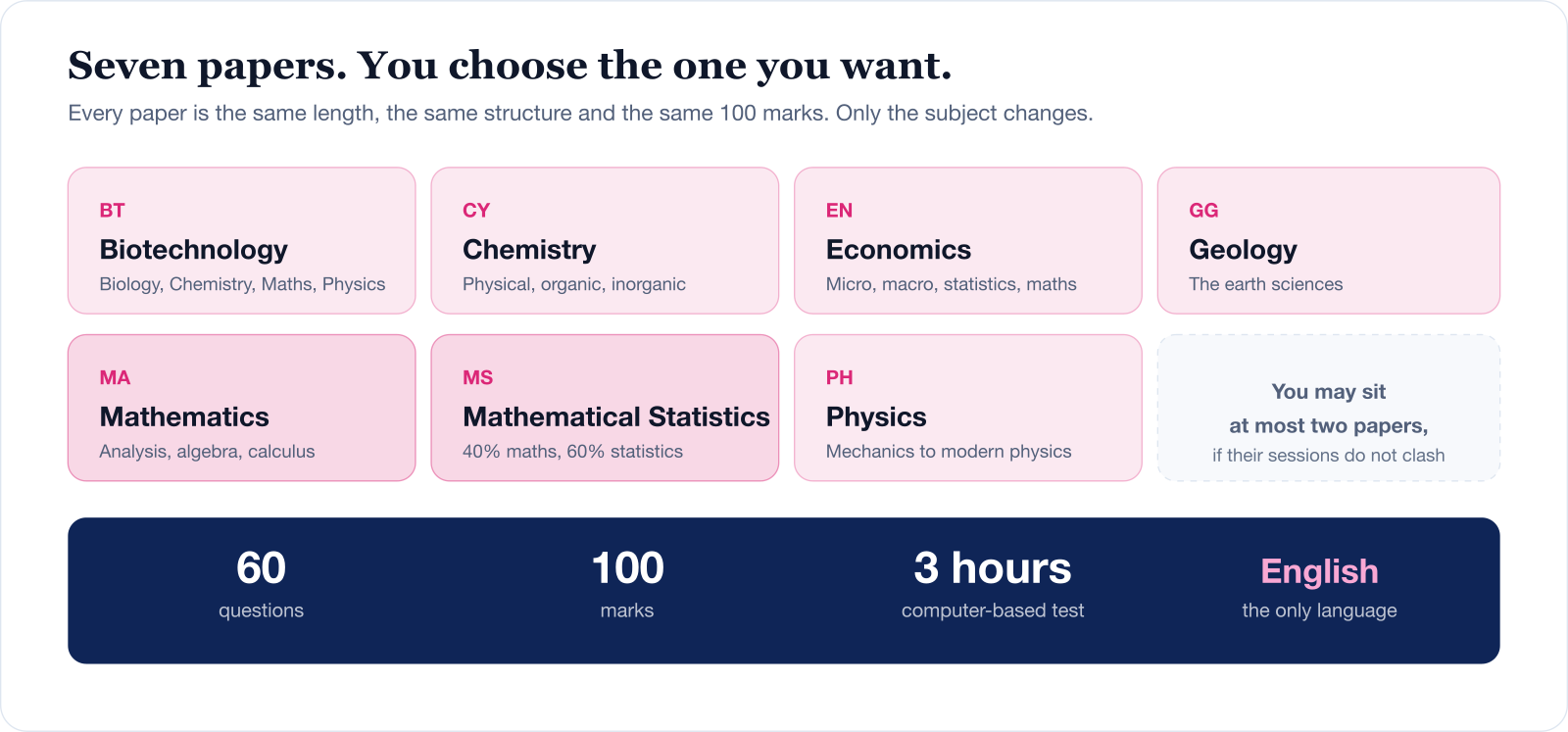
JAM is not one paper with a choice of sections. It is seven separate papers, each identified by a two-letter code, and you register for the one matching the subject you want to study. Every one of them runs to the same length, the same structure and the same 100 marks — only the subject changes.
You may appear in two papers if their sessions do not clash, which is worth knowing if you are, say, equally placed between Mathematics and Mathematical Statistics. It doubles the preparation, so it is a decision to make early rather than a safety net to reach for in January.
Your undergraduate degree does not have to be in the subject you sit. A physics graduate can write the Mathematics paper. What you must satisfy is the admitting institute’s requirement for the programme you want — and that is a separate list, checked at admission rather than at the exam.
2. How the paper is built
Three sections, in the same order in every paper, and the difference between them is the most useful thing to understand before you sit down.
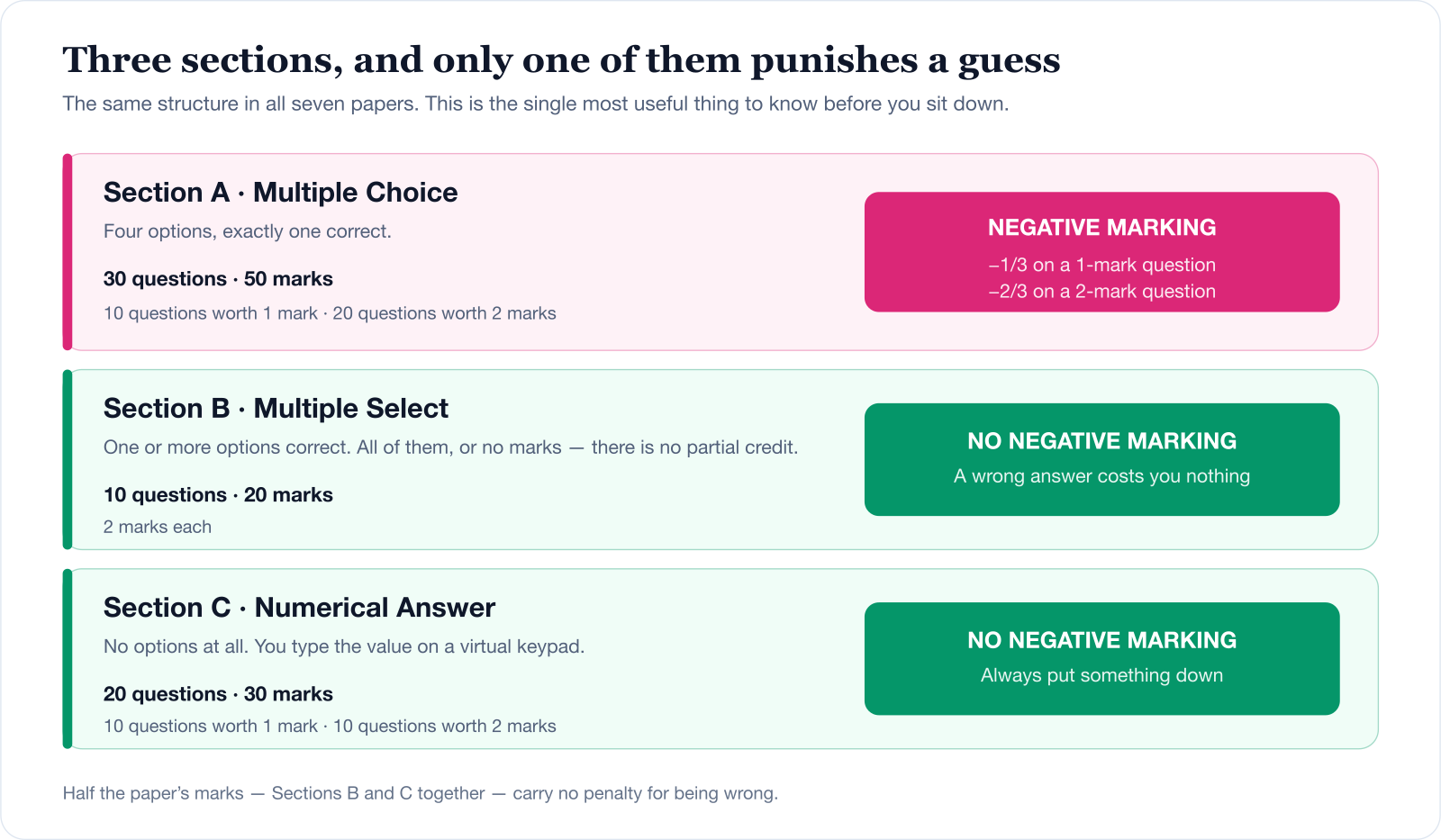
| Section | Type | Questions | Marks | Negative marking |
| A | Multiple choice (one correct) | 30 | 50 | Yes — −1/3 and −2/3 |
| B | Multiple select (one or more correct) | 10 | 20 | No |
| C | Numerical answer (type the value) | 20 | 30 | No |
| Total | 60 | 100 |
Half the paper’s marks carry no penalty at all. Sections B and C are worth 50 of the 100 marks between them, and a wrong answer in either costs nothing more than the marks you did not earn. In Section C especially, leaving a box empty and typing a considered attempt have exactly the same downside — which is to say, none.
Section A is where care is needed. A wrong 2-mark answer takes two-thirds of a mark off, so the swing between a right and a wrong answer is 2⅔ marks. Three of those is most of a 2-mark question thrown away.
One more rule that catches people in Section B: there is no partial credit. If a question has three correct options and you select two of them, you score zero — the same as if you had selected nothing. All of them, or none.
Other things to know about the paper
- It is a computer-based test and it is in English only — there is no second language option.
- An on-screen calculator is provided, and it is the only one you may use. Physical calculators, tables and charts are not allowed.
- A virtual keypad is used to type Section C answers, so it is worth being comfortable with it before exam day rather than discovering it during the paper.
3. Who may sit it
| Rule | What it says |
| Qualifying degree | A bachelor’s degree. Final-year students may apply, and produce the degree at admission. |
| Minimum marks to apply | The old percentage cut-off has been relaxed — a pass in the bachelor’s degree is what is required to appear. |
| Age limit | None. |
| Number of attempts | No limit. You may sit JAM as many times as you like. |
| Subject of your degree | Not required to match the paper you sit, though the programme you apply to may require specific subjects. |
That table is unusually short for an Indian entrance exam, and the reason is worth stating plainly: JAM has no age limit and no attempt limit. Nothing about a gap year, a job, or a previous attempt disqualifies you. If you graduated four years ago and want to return to academics, the exam is open to you on exactly the same terms as a final-year student.
The one thing that is conditional is admission, not the exam. Each programme at each institute sets its own minimum educational qualification — which subjects you must have studied, and to what level — and those are published with that year’s brochure. Read them for the specific programmes you want before you register, not after your result.
4. What a JAM rank gets you
JAM produces an All India Rank in each paper, and that rank feeds two different admission processes.
| Route | Where it admits you |
| The JAM portal itself | The IITs and IISc — you submit an admission form with your programme choices after the result. |
| CCMN | Centralised counselling that uses your JAM score for NITs, IIITs and other centrally funded institutes, run separately. |
The programmes on offer are not only two-year MSc degrees. Depending on the institute and the subject, a JAM rank can also lead to Joint MSc–PhD, MSc–PhD dual degree and MSc–MTech programmes — several of which are difficult to enter by any other route, and which are the real reason many candidates sit this exam rather than a university-level entrance.
Applying to CCMN is a separate registration with its own fee and its own deadline. Every year, candidates with usable ranks miss NIT admission simply because they assumed one application covered everything. It does not.
5. The syllabus, in general terms
Each paper has its own published syllabus, and they are built on standard undergraduate material rather than on anything exotic. Broadly:
- Mathematics (MA) — real analysis, sequences and series, calculus of one and several variables, differential equations, vector calculus, group theory and linear algebra.
- Mathematical Statistics (MS) — roughly 40% mathematics and 60% statistics: probability, random variables, distributions, estimation and testing of hypotheses.
- Physics (PH) — mathematical methods, mechanics, oscillations and waves, electricity and magnetism, thermodynamics, modern physics and electronics.
- Chemistry (CY) — physical, organic and inorganic chemistry, at the level a three-year degree covers them.
- Biotechnology (BT) — biology, chemistry, mathematics and physics together, at roughly 10+2 to first-year-degree level for the non-biology parts.
- Economics (EN) — microeconomics, macroeconomics, statistics for economics and mathematics for economics.
- Geology (GG) — the planet and its processes: mineralogy, petrology, structural geology, palaeontology, stratigraphy and economic geology.
The official syllabus for your paper is published with the brochure each year and it is short enough to read in one sitting. Do that before you buy a book — coaching modules routinely include topics that the syllabus does not, and the exam has no obligation to be interested in them.
6. What the exam is actually asking for
Reduced to its essentials, the paper tests three different things and it is worth knowing which is which.
- Section A tests judgement under a penalty. Thirty questions, half the marks, and the only place where being wrong is worse than being silent.
- Section B tests completeness. Multiple-select with no partial credit is a deliberately harsh format: knowing that two options are right is worth nothing if you cannot rule on the other two.
- Section C tests whether you can finish. No options means no working backwards from the answers, no elimination, and no luck — you either carry the calculation through or you do not.
Sixty questions in three hours is three minutes each, and the paper is designed so that most candidates do not finish comfortably. Which questions you leave is therefore part of the exam, not a failure to complete it.
How to prepare for each paper, which topics carry the most marks, and how to actually attempt three hours of this — those are subject-by-subject questions, and we will take them up in their own articles. This one is the ground you are standing on.
7. The seven papers, one guide each
Everything above is true of all seven JAM papers. What differs — the seat count, the cutoff, the syllabus and what the paper actually rewards — is subject by subject, and each has its own guide with that year’s data in it.
| Paper | What its guide covers |
| Physics (PH) | The largest paper — 952 of the 3,037 M.Sc. seats — and the eight units the rest of it is solved with |
| Chemistry (CY) | The second-largest, and the steadiest cutoff of the seven |
| Mathematics (MA) | The mildest marking scheme of the set, and the most volatile cutoff |
| Geology (GG) | Mid-table on every measure, with one structural fact that decides the paper |
| Mathematical Statistics (MS) | Not a statistics paper: 40% of it is mathematics, by design |
| Biotechnology (BT) | The tightest paper in JAM, and the only one built from four subjects at once |
| Economics (EN) | The hardest to get into — 58 seats — and two of its five units are not economics |
Read this page for the rules of the exam, and your paper’s guide for what those rules cost in your subject.
Quick answers
Frequently asked
Is there negative marking in IIT JAM?
Only in Section A. A wrong 1-mark MCQ costs one-third of a mark and a wrong 2-mark MCQ costs two-thirds. Sections B and C — worth 50 of the 100 marks between them — have no negative marking at all.
How many questions are there in IIT JAM?
Sixty, for 100 marks, in three hours. Thirty multiple-choice questions in Section A (50 marks), ten multiple-select in Section B (20 marks) and twenty numerical-answer questions in Section C (30 marks). Every one of the seven papers has this same structure.
Is there partial credit in the multiple-select section?
No. In Section B you score only if you select every correct option and no incorrect one. Getting two of three right scores the same as answering nothing.
How many attempts do I get for IIT JAM?
There is no limit. You may sit IIT JAM as many times as you wish, provided you meet the qualifying-degree requirement. There is also no age limit.
Can I appear for two IIT JAM papers?
Yes, for up to two, provided their sessions do not clash. It doubles the preparation, so it is a decision worth making early rather than treating as a backup.
Does my bachelor’s degree have to be in the same subject as the paper?
Not to sit the exam — a physics graduate may write the Mathematics paper. But each programme sets its own minimum educational qualification for admission, so check the requirements for the specific programmes you want before you register.
What percentage do I need in my degree to apply for IIT JAM?
The old percentage cut-off has been relaxed — a pass in the bachelor’s degree is what is needed to appear. Individual programmes may still set their own minimum for admission, which is published with that year’s brochure.
Does IIT JAM only get me into IITs?
No. The JAM portal handles admission to the IITs and IISc, and a separate centralised counselling process called CCMN uses your JAM score for NITs, IIITs and other centrally funded institutes. CCMN is a separate registration with its own fee and deadline.
Keep reading