
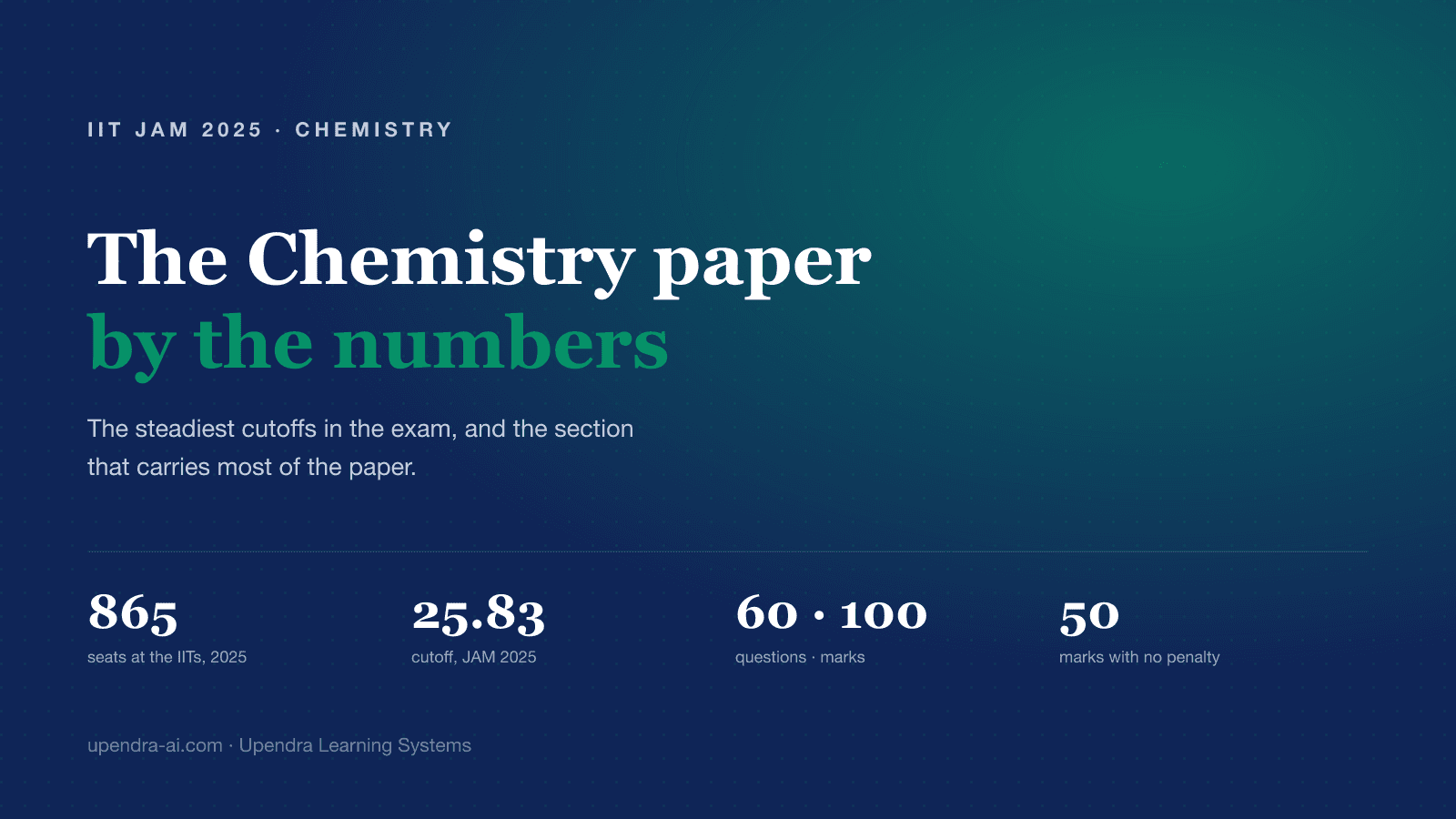
Chemistry is the second-largest IIT JAM paper, with 865 of the 3,037 M.Sc. seats at the IITs. It is also the steadiest of the seven: across JAM 2021 to 2025 its qualifying cutoff moved through a range of about eight marks, in an exam where two papers swung by more than twenty.
This article covers the CY paper specifically — where it sits, how it is built, what the syllabus contains and what the cutoffs say.
If you have not sat IIT JAM before, the general guide to the exam covers the rules that apply to all seven papers — the marking scheme, eligibility and how admission actually works. This page assumes them.
Which year is this data from? Every figure here is from the IIT JAM 2025 cycle — the 2025 seat matrix, and the qualifying cutoffs declared with the 2025 result — with the cutoff series running back to JAM 2021. The exam pattern, marking scheme and eligibility rules are as they stand now.
This page is updated after each year’s result rather than replaced, so the older figures stay here beside the new ones. A single year tells you where the bar was; five years tell you how far it moves, which is the more useful thing to know while you are preparing.
1. Where the Chemistry paper sits
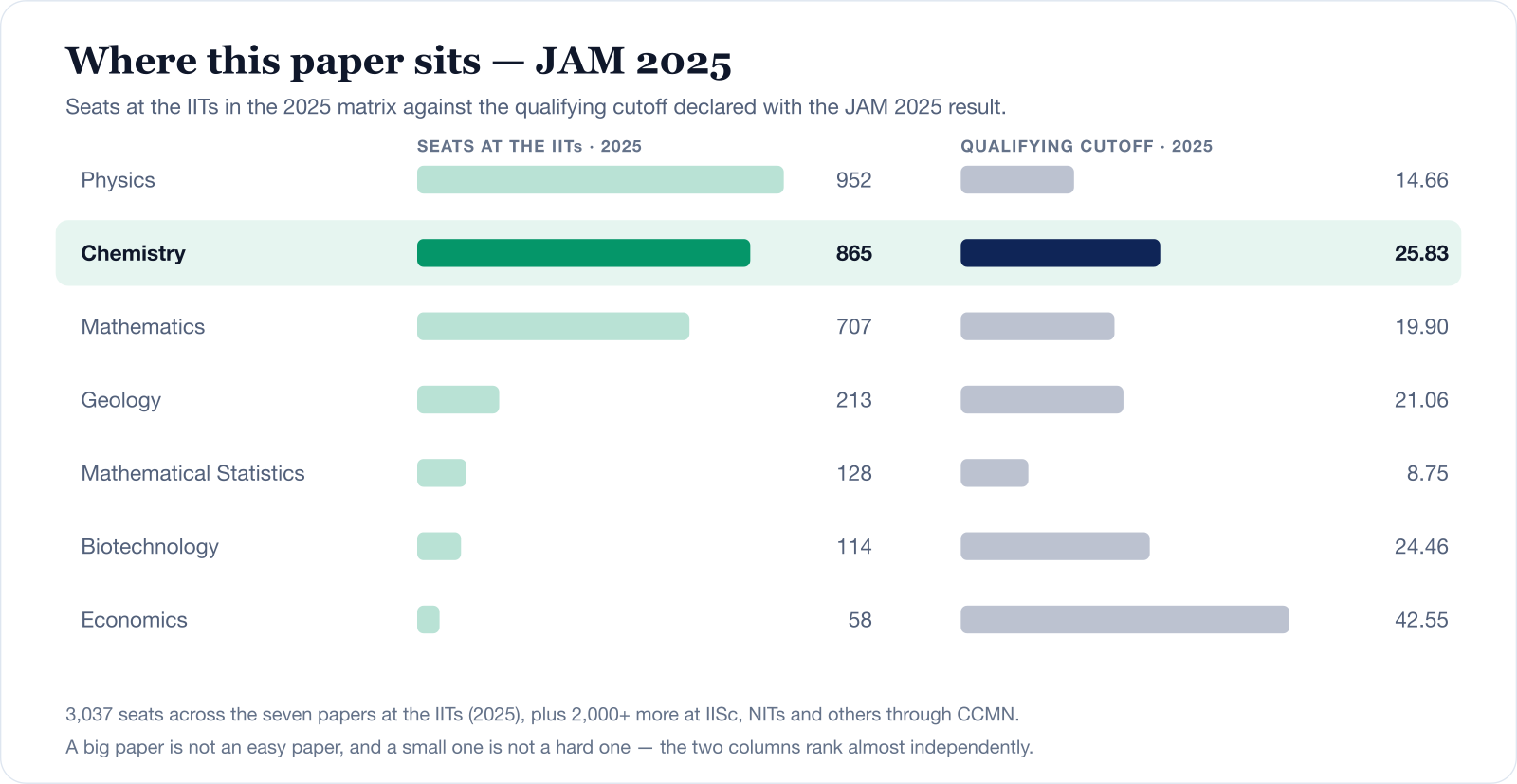
Chemistry is unusual in having both a large seat count and a consistently high cutoff. That combination says something specific: the paper allows candidates to score. A cutoff of 25.83 is not evidence of a harder paper than Physics at 14.66 — it is evidence of an easier one, because the cutoff rises when more candidates score more marks.
This is the most counter-intuitive thing about JAM cutoffs and it is worth getting straight: a high cutoff means the paper was easier that year, not harder. The bar is set by how the cohort performed, so it rises when the paper is kind and falls when it is brutal.
2. The paper itself
Every JAM paper has the same three sections, and the difference between them decides more of your score than most candidates realise.
| Section | Type | Questions | Marks | Negative marking |
| A | Multiple choice, one correct | 30 | 50 | −1/3 and −2/3 |
| B | Multiple select, one or more correct | 10 | 20 | None |
| C | Numerical answer, type the value | 20 | 30 | None |
Fifty of the hundred marks carry no penalty for a wrong answer. In Sections B and C a blank and a wrong answer score identically, so there is no defensive reason to leave a numerical question untouched. Section A is the only place a guess costs you anything — and a wrong 2-mark MCQ swings 2⅔ marks against you once you count the marks you did not get.
Section B has one more rule worth stating plainly: there is no partial credit. Select two of three correct options and you score zero, exactly as if you had selected nothing.
3. The syllabus
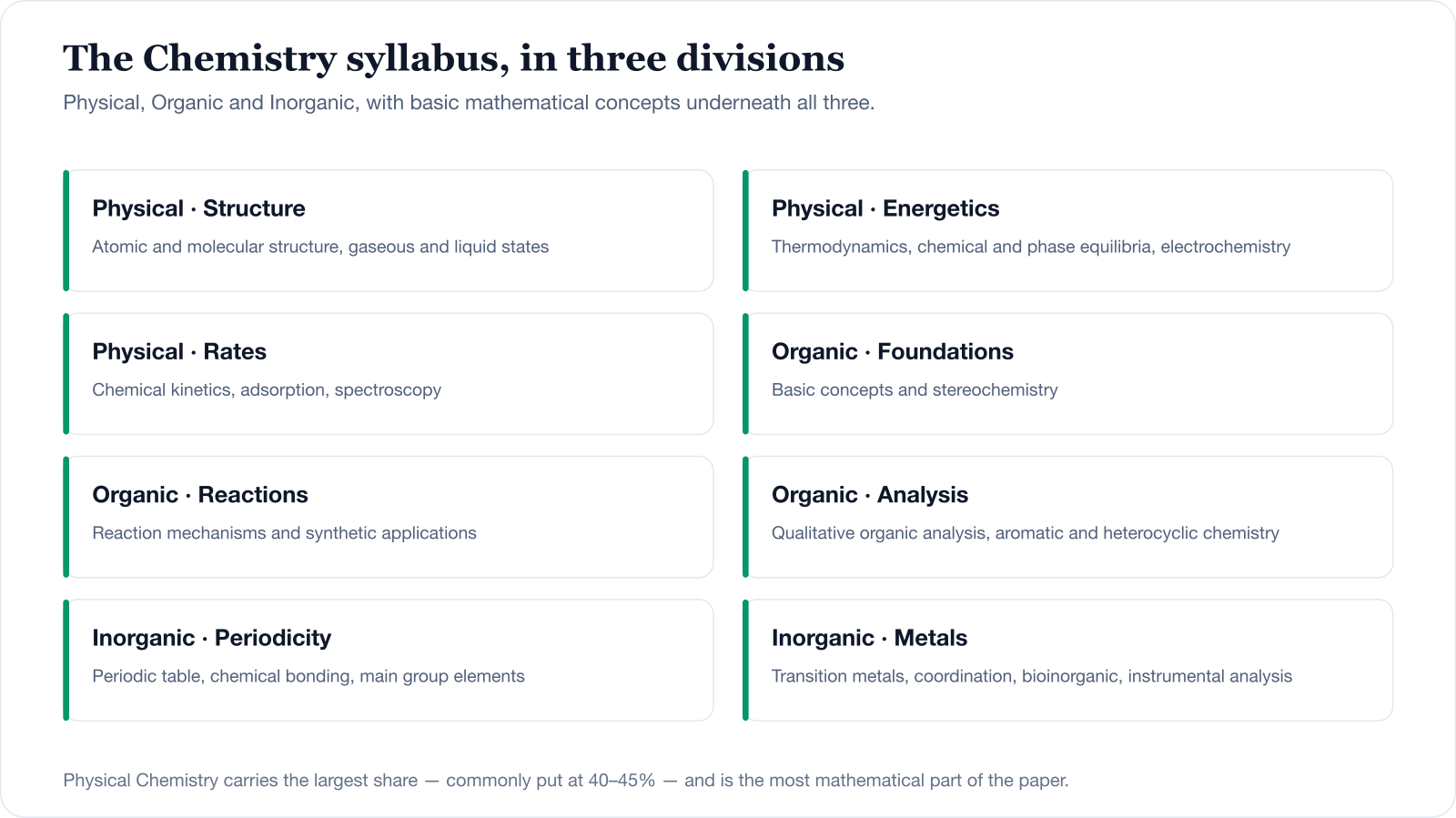
The CY syllabus is B.Sc. chemistry in its three conventional divisions, with one addition that catches people out: basic mathematical concepts sit underneath all of it, and are examinable.
Physical Chemistry carries the largest share of the paper — commonly put at 40–45% — and it is also the most mathematical part of it. Thermodynamics, kinetics, electrochemistry and equilibria are all calculation subjects, and they are where the Section C numerical questions mostly come from. A candidate strong on organic mechanisms and weak on physical chemistry is weak in the half of the paper that is most reliably scoreable.
Organic and Inorganic split the remainder. Organic rewards understanding of mechanism over memorised reactions; Inorganic rewards systematic memory more than anything else in the syllabus, which makes it the cheapest marks in the paper for a candidate willing to be methodical about the periodic table, bonding and coordination chemistry.
4. What five years of cutoffs say
| JAM year | General | OBC-NCL / EWS | SC / ST / PwD |
| JAM 2021 | 19.53 | 17.58 | 9.77 |
| JAM 2022 | 27.81 | 25.03 | 13.90 |
| JAM 2023 | 20.51 | 18.46 | 10.26 |
| JAM 2024 | 25.38 | 22.84 | 12.69 |
| JAM 2025 | 25.83 | 23.25 | 12.91 |
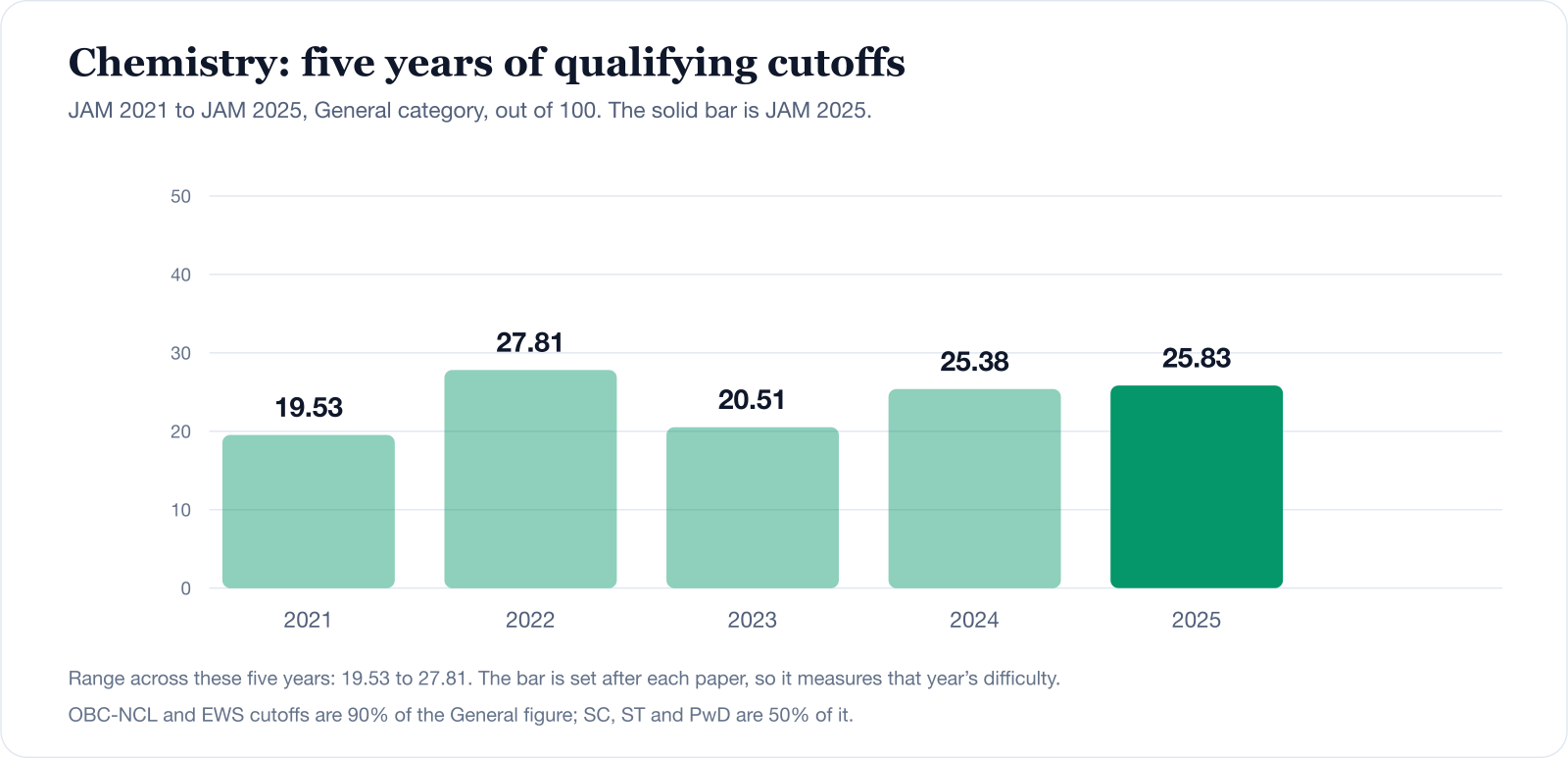
The General column is the figure declared with each year’s result. The other two are not set separately — JAM fixes them at 90% and 50% of the General cutoff, so they follow from it exactly, and you can always derive your own category’s number that way.
Read the series rather than the latest bar. Over these five years the Chemistry cutoff has ranged from 19.53 to 27.81 out of 100, and the reason is that the bar is set after the paper — it measures how that year’s cohort scored. A cutoff that falls means the paper was harder, not that fewer people wanted the seats; a cutoff that rises means it was kinder.
That is also why last year’s figure is a poor target. It is a description of a paper you will not sit.
And in every year, this is the bar to appear on the merit list — not the bar for a seat. Admission is decided later by All India Rank against each programme’s closing rank, which is published during counselling.
5. Who may sit it
| Rule | What it says |
| Qualifying degree | A bachelor’s degree. Final-year students may apply and produce it at admission. |
| Minimum marks to apply | The old percentage cut-off has been relaxed — a pass in the degree is what is needed to appear. |
| Age limit | None. |
| Attempts | No limit. |
| Degree subject | Need not match the paper you sit — but the programme you apply to sets its own subject requirements. |
That last row is the one to act on. Sitting the paper is open to anybody with a degree; being admitted to a specific M.Sc. programme is not. Each institute publishes a minimum educational qualification for each programme — which subjects you must have studied, and at what level — and those are the lists to read before you register, not after your result.
6. What the paper is asking for
- Physical Chemistry is the load-bearing section. It is the largest share of the paper and the source of most numerical questions.
- Do not skip the mathematics. Basic mathematical concepts are in the syllabus and they are what physical chemistry is solved with.
- Inorganic is the cheapest section to improve. It rewards systematic revision more directly than any other part of the paper.
- Attempt everything in Sections B and C. Half the marks carry no penalty for a wrong answer.
Chapter-level weightage and attempt strategy are questions for their own articles. This one is the map.
Quick answers
Frequently asked
How many M.Sc. Chemistry seats are there through IIT JAM?
865 at the IITs in the 2025 matrix, second only to Physics, out of 3,037 seats in total across the seven papers.
What is the qualifying cutoff for IIT JAM Chemistry?
The General-category figure was 25.83 in 2025, 25.38 in 2024 and 20.51 in 2023 — the steadiest series of any JAM paper over that period.
Why is the Chemistry cutoff higher than the Physics cutoff?
Because the cutoff measures how the cohort scored, not how hard the paper was to prepare for. A higher cutoff means candidates scored more marks — that is, the paper was kinder — so a high figure is not evidence of a harder subject.
Which section of the JAM Chemistry syllabus carries the most marks?
Physical Chemistry, commonly put at 40–45% of the paper. It is also the most mathematical part of it and the source of most numerical-answer questions, so it is the section that most directly rewards practice.
Is there negative marking in this IIT JAM paper?
Only in Section A. A wrong 1-mark MCQ costs one-third of a mark and a wrong 2-mark MCQ costs two-thirds. Sections B and C — 50 of the 100 marks between them — carry no negative marking at all, so a blank and a wrong answer score exactly the same.
Is there partial credit in Section B?
No. You must select every correct option and no incorrect one. Selecting two of three correct options scores zero, exactly as if you had selected nothing.
Does my bachelor’s degree have to be in this subject?
Not to sit the paper — there is no restriction on which paper you register for. But each M.Sc. programme sets its own minimum educational qualification for admission, so check the requirements for the specific programmes you want before you register.
How are the category cutoffs decided?
By a fixed ratio off the General figure — OBC-NCL and EWS are 90% of it, and SC, ST and PwD are 50% of it. You can always derive your own category’s number from the General one.
Keep reading