
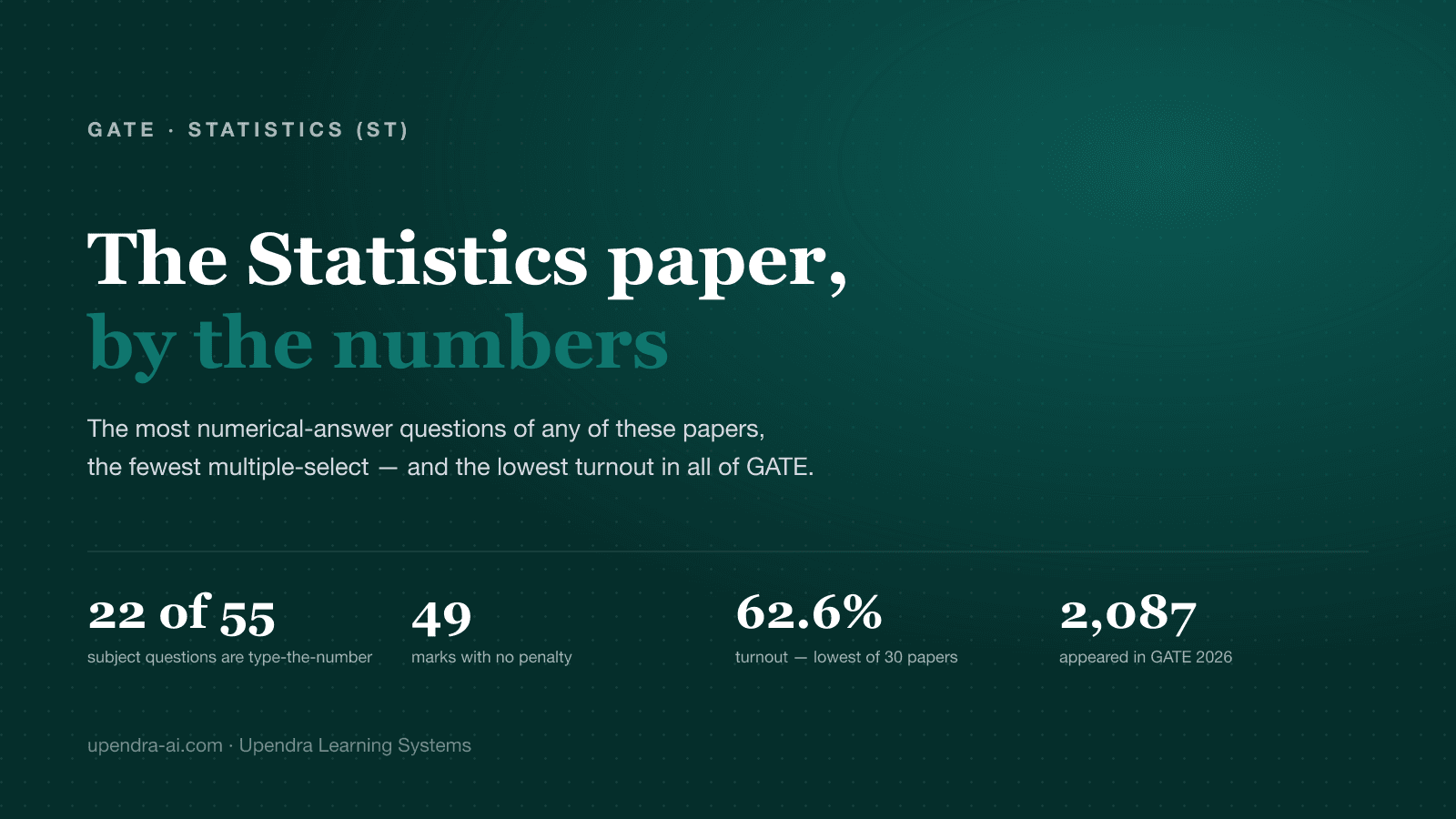
GATE Statistics is the smallest paper covered in this series and the one with the most distinctive shape. In GATE 2025 it printed 22 numerical-answer questions — more than any of the other four — and only eight multiple-select, the fewest. That is a paper built for people who can compute an answer rather than recognise one.
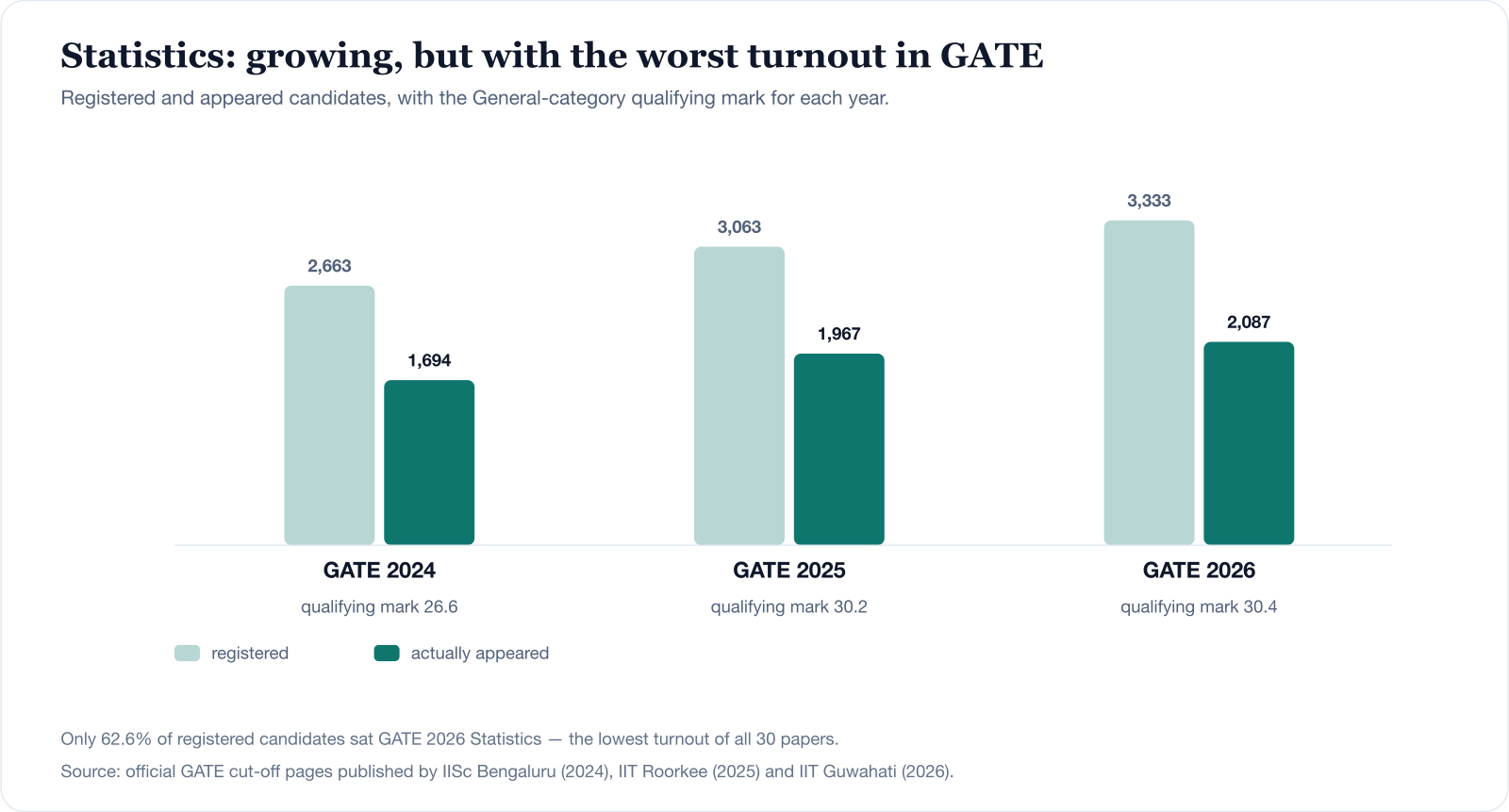
It also has the worst turnout in the entire exam. Of 3,333 candidates who registered for GATE 2026 Statistics, 2,087 turned up — 62.6%, the lowest of all 36 rows on the official cut-off table. Meanwhile registrations have grown 25% in two years, from 2,663 to 3,333.
It is one of six GATE papers with no Engineering Mathematics section: all 85 subject marks are statistics and the mathematics it rests on.
This article is about the Statistics paper specifically: what is in it, what the qualifying mark and the GATE score actually measure, what the syllabus contains, and what IIT Madras has changed for GATE 2027.
If you have not sat GATE before, the general guide to the exam covers the rules common to all thirty papers — the marking scheme, eligibility and what a score is used for. This page assumes them.
Which year is this data from? The exam pattern, marking scheme, qualifying-mark formula, score formula, eligibility and fee are from the GATE 2026 Information Brochure published by IIT Guwahati. Candidate numbers and qualifying marks are from the official cut-off pages for GATE 2024, 2025 and 2026 — published by IISc Bengaluru, IIT Roorkee and IIT Guwahati respectively. The question-type breakdown is counted from the official GATE 2025 answer key.
GATE 2027 is organised by IIT Madras, and the syllabi have been revised. What changed for this paper is set out in section 5 below. This page is updated after each cycle rather than replaced, so the older figures stay here beside the new ones.
1. One exam, three destinations
Before the paper itself, the thing GATE is for. One score does three different jobs, and they do not treat it the same way.
| What it is used for | How the score is treated |
| M.Tech, M.E., M.S. and M.Sc. at IITs, IISc, NITs and other centrally funded institutes | A three-year-old score is accepted. Many programmes carry a monthly stipend. |
| PhD admission at the same institutes | A three-year-old score is accepted, often directly after a bachelor’s degree. |
| Recruitment by public sector companies | Usually the current year’s score only. |
That last row costs people a year. Your scorecard is valid for three years and institutes honour it; most PSU recruitment notices ask for the score from that year’s exam.
2. What is actually in the paper
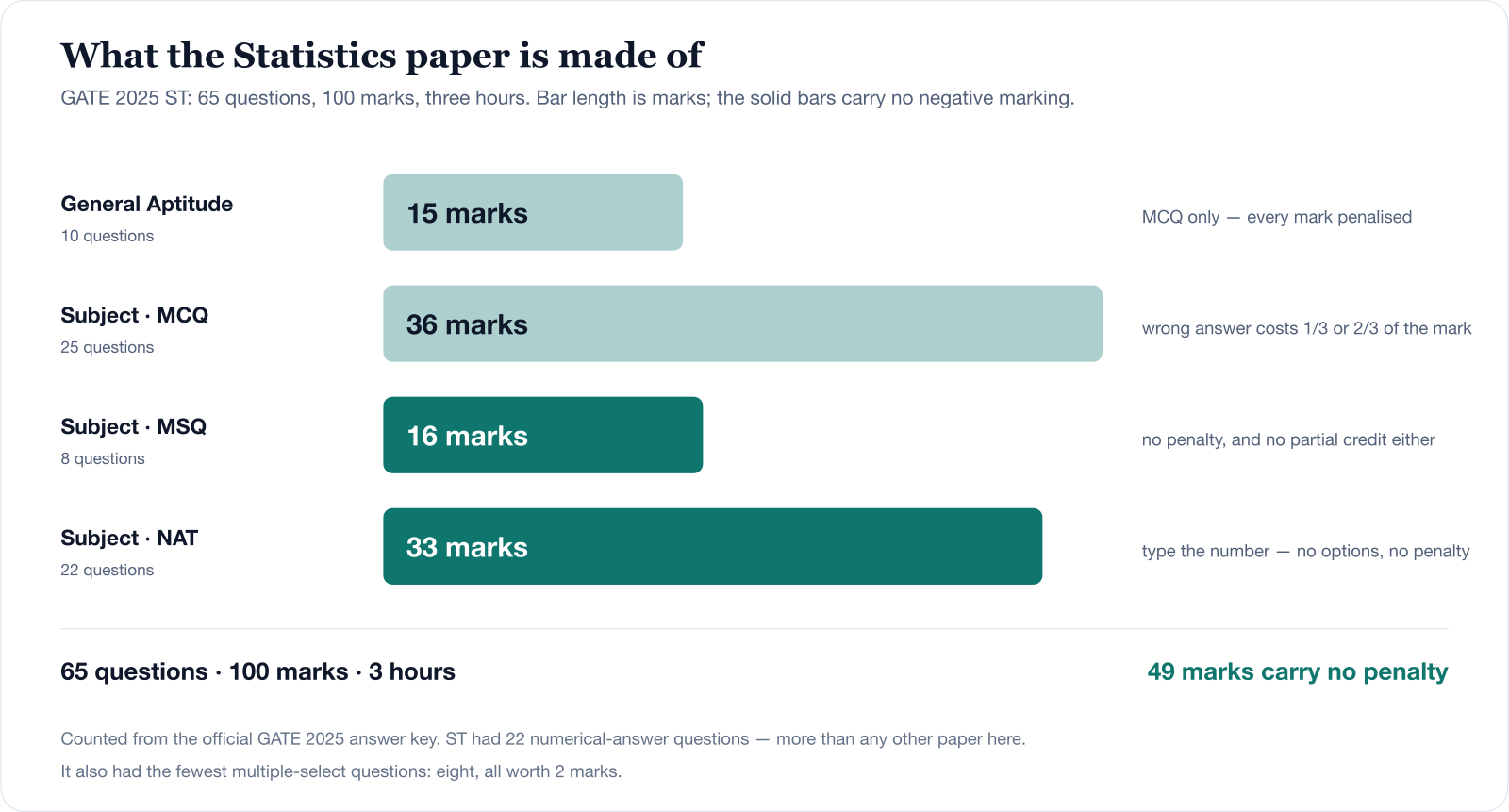
Every GATE paper is the same shape: 65 questions, 100 marks, three hours, on a computer, in English. General Aptitude is 15 marks and is identical for all 30 papers; the remaining 85 are yours.
What differs between papers, and between years, is the mix of question types — and that mix decides how much of the paper you can attempt without risk. Here is GATE 2025 Statistics, counted from the official answer key.
| Section | Questions | Marks | Negative marking |
| General Aptitude — MCQ only | 10 | 15 | Yes, on every question |
| Subject — MCQ | 25 | 36 | Yes |
| Subject — MSQ | 8 | 16 | None |
| Subject — NAT | 22 | 33 | None |
| Total | 65 | 100 |
| Question type | What it is | Wrong answer costs |
| MCQ | Four options, exactly one correct | −1/3 on a 1-mark question, −2/3 on a 2-mark question |
| MSQ | One or more options correct | Nothing — but there is no partial credit either |
| NAT | Type the number; no options given | Nothing |
49 of the 85 subject marks carried no penalty at all. In an MSQ or a NAT, a blank and a wrong answer score exactly the same — zero — so leaving one untouched costs precisely as much as an attempt that turns out wrong, and gains nothing.
MSQ carries its own trap in the other direction. With no partial credit, knowing two of four options are correct is worth nothing unless you can also rule on the other two. And an MSQ is not obliged to have more than one correct option: in GATE 2025 Statistics, 0 of the 8 multiple-select questions had exactly one correct answer. Stopping after the first correct tick is how a well-prepared candidate scores zero.
One more line worth carrying: all 15 marks of General Aptitude are negatively marked, because the whole section is MCQ. It is the only part of the paper that is guaranteed to punish a guess.
3. What the qualifying mark actually is
Most people read the GATE cut-off as a target set by an examiner. It is not. It is a formula, and the brochure prints it:
Qualifying mark for the General category = max(25, min(40, μ + σ))
where μ is the mean and σ the standard deviation of the marks of everyone who appeared in that paper.
Two consequences follow immediately, and they change how you should read the number.
The cut-off is a description of the cohort, not of the paper’s difficulty. It is literally one standard deviation above the average mark. If it comes out low, the average candidate scored low; if it comes out high, they scored well.
And it is clamped between 25 and 40. A paper whose μ + σ falls below 25 publishes 25 anyway, and one whose μ + σ exceeds 40 publishes 40. When you see either of those exact numbers, the formula has been overruled by the floor or the ceiling, and the published figure tells you nothing about the cohort beyond “below 25” or “above 40”. The ceiling is recent: in GATE 2024 six papers qualified above 40, with one at 49.0. Since GATE 2025 no paper has exceeded 40.
| Year | Registered | Appeared | Turnout | Cut-off (GEN) | OBC-NCL / EWS | SC / ST / PwD |
| GATE 2024 | 2,663 | 1,694 | 63.6% | 26.6 | 23.9 | 17.7 |
| GATE 2025 | 3,063 | 1,967 | 64.2% | 30.2 | 27.1 | 20.1 |
| GATE 2026 | 3,333 | 2,087 | 62.6% | 30.4 | 27.3 | 20.2 |
The other two columns are not set separately. The brochure fixes them by ratio: OBC-NCL and EWS at 9/10 of the General mark, and SC, ST and PwD at 2/3 of it. Published figures are rounded to one decimal, so the arithmetic can look 0.1 out; the rule itself is exact.
The turnout number is the one to sit with. Of 3,333 candidates registered for GATE 2026 Statistics, 1,246 did not appear — a turnout of 62.6%, the lowest of all 36 rows on the official cut-off table, and more than sixteen points below the GATE-wide average of 78.8%.
It cuts both ways. A third of your notional competition is not in the room. But the bar is set from the marks of those who are, so a small, self-selected, serious cohort is exactly the kind that produces a high μ + σ — which is why Statistics has qualified above 30 for two years running while Chemistry and Mathematics sat on the floor of 25.
4. What a GATE score actually means
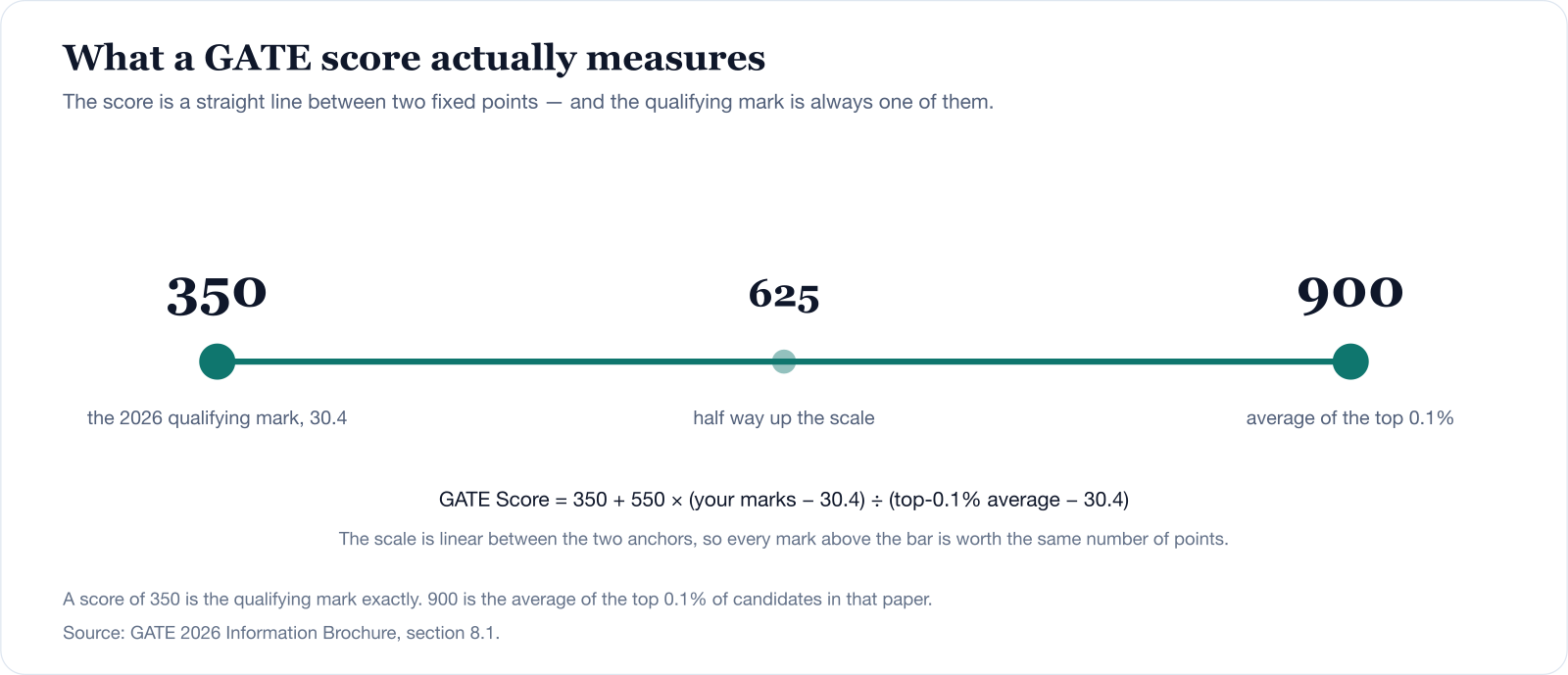
A GATE score is not your marks, and it is not a percentile. It is a linear rescaling with two fixed anchors, and once you know them the whole thing is readable:
- A score of 350 is exactly the qualifying mark. If you scraped through, you scored 350.
- A score of 900 is the average of the top 0.1% of candidates in your paper (or the top 10, whichever is larger).
Everything between is a straight line. The formula in the brochure is GATE Score = 350 + 550 × (your marks − Mq) ÷ (top-0.1% average − Mq), where Mq is the General-category qualifying mark.
This is why a score is comparable across papers in a way that marks are not. Two candidates on 700 in different subjects sit at the same point between their own paper’s bar and its top. It is also why the score depends on how well the best candidates did that year: if the top 0.1% average is lower, the same marks are worth more.
The scorecard is valid for three years. Institutes honour that; most public sector companies do not — their recruitment notices usually ask for the current year’s score. If a PSU job is the goal, the year you sit is part of the plan.
5. The syllabus, and what changes in GATE 2027
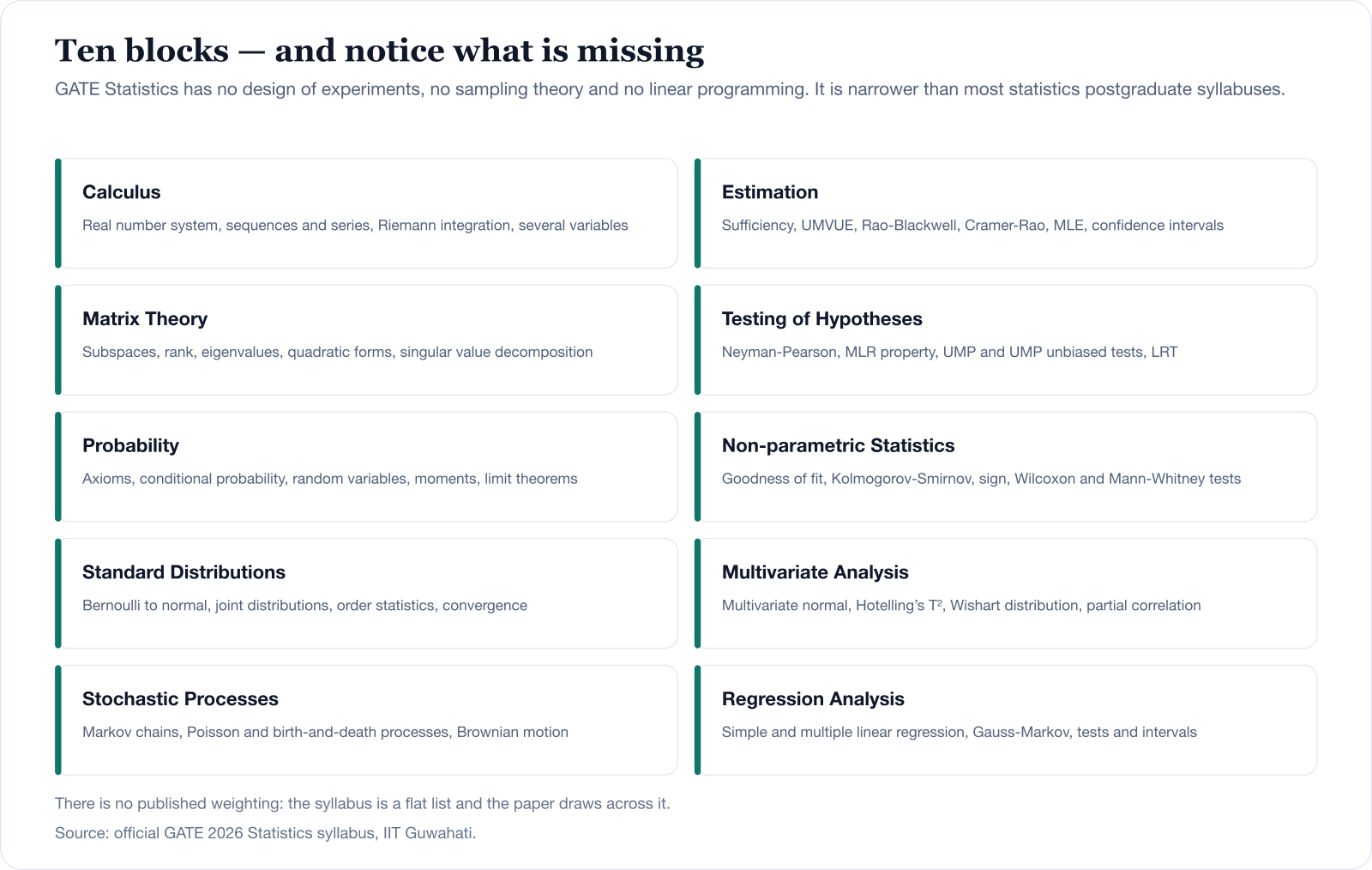
Ten blocks — and what is worth noticing is what is absent. GATE Statistics has no design of experiments, no sampling theory and no linear programming. Those appear in most postgraduate statistics syllabuses and in CSIR NET’s statistics unit; they are not in this paper. What it does have is a deep treatment of inference: sufficiency, UMVUE, Rao-Blackwell, Cramer-Rao, Neyman-Pearson, monotone likelihood ratio, UMP and UMP-unbiased tests.
That shape explains the 22 numerical-answer questions. A paper built on estimation and testing produces questions with a number at the end of them.
What IIT Madras changed for GATE 2027
The GATE 2027 Statistics syllabus is reorganised from ten blocks into twelve numbered sections. Nothing is removed. The single large distributions block is split into three — Standard Univariate Distributions, Joint Distributions and Convergence of Random Variables — which pulls modes of convergence and the limit theorems out into a section of their own rather than leaving them buried at the end of a long paragraph.
Read that as a signal about emphasis rather than about content. Giving convergence its own section is the syllabus telling you it expects to examine it properly.
6. Who may sit it, and what it costs
| Rule | What it says |
| Qualifying degree | Currently in the third year or higher of any undergraduate degree, or already holding one. |
| Degree subject | Need not match the paper. You choose the paper; the admitting institute sets its own subject requirements. |
| Age limit | None. |
| Attempts | No limit. |
| Two papers | You may sit up to two papers in one cycle, from the published list of allowed combinations. |
| Application fee (per paper) | ₹1,000 for female, SC, ST and PwD candidates · ₹2,000 for everyone else. Both rise by ₹500 in the extended period. |
The third-year rule is worth acting on rather than noting. You do not need the degree in hand, and a good score obtained in your third year is valid for three years — which covers the entire window in which you might want to use it.
7. What this paper is asking for
- Attempt every NAT. Twenty-two of the 55 subject questions in GATE 2025 were type-the-number, worth 33 marks, with no penalty for being wrong. There is never a reason to leave one blank.
- Be able to compute, not just recognise. The paper’s shape — most NAT, fewest MSQ — rewards someone who can carry a derivation to a number.
- Inference is the spine of this syllabus. Sufficiency, UMVUE, Neyman-Pearson and the MLR property are where the depth is, and where the marks are.
- Do not prepare design of experiments or sampling theory. They are genuinely not in this syllabus, whatever a general statistics book suggests.
- Do not ignore General Aptitude. Fifteen marks, no statistics in it, and all of it negatively marked.
- Note the 2027 reorganisation. Convergence of random variables now has a section of its own, which is the syllabus telling you it will be examined properly.
The syllabus is public and every candidate has the same one. In the smallest paper here, with the highest share of computable answers, what separates results is arithmetic you can finish under a clock.
Quick answers
Frequently asked
What was the GATE Statistics cut-off in 2026?
30.4 marks out of 100 for the General category, 27.3 for OBC-NCL and EWS, and 20.2 for SC, ST and PwD. It has qualified above 30 for two years running, while Chemistry and Mathematics sat on the floor of 25.
Why is the GATE Statistics turnout so low?
Of 3,333 candidates who registered for GATE 2026 Statistics, 2,087 appeared — a turnout of 62.6%, the lowest of all 36 rows on the official cut-off table and more than sixteen points below the GATE-wide average of 78.8%. A third of the notional competition is not in the room, but the bar is set from the marks of those who are.
What is the question mix in GATE Statistics?
In GATE 2025 the subject section had 25 MCQs, 8 multiple-select questions and 22 numerical-answer questions — the most NAT and the fewest MSQ of the five papers in this series. Forty-nine of the 85 subject marks carried no negative marking.
What is in the GATE Statistics syllabus?
Calculus, Matrix Theory, Probability, Standard Distributions, Stochastic Processes, Estimation, Testing of Hypotheses, Non-parametric Statistics, Multivariate Analysis and Regression Analysis. Notably it has no design of experiments, no sampling theory and no linear programming, all of which appear in most postgraduate statistics syllabuses.
Has the GATE 2027 Statistics syllabus changed?
It is reorganised from ten blocks into twelve numbered sections, with nothing removed. The single distributions block is split into three — Standard Univariate Distributions, Joint Distributions, and Convergence of Random Variables — which gives modes of convergence and the limit theorems a section of their own.
What is the GATE cut-off actually based on?
A formula printed in the Information Brochure: the qualifying mark for the General category is max(25, min(40, μ + σ)), where μ is the mean and σ the standard deviation of the marks of everyone who appeared in that paper. It is one standard deviation above the average, clamped between 25 and 40. OBC-NCL and EWS qualify at 9/10 of that figure, and SC, ST and PwD at 2/3.
What does a GATE score of 350 mean?
It means exactly the qualifying mark. The GATE score is a linear scale with two fixed anchors: the qualifying mark is assigned 350, and the average of the top 0.1% of candidates in that paper is assigned 900. Everything between is a straight line, which is why scores are comparable across papers when marks are not.
Is there negative marking in GATE?
On MCQs only. A wrong 1-mark MCQ costs 1/3 of a mark and a wrong 2-mark MCQ costs 2/3. Multiple-select (MSQ) and numerical-answer (NAT) questions carry no negative marking — but MSQ has no partial credit either, so you score only by identifying every correct option. All 15 marks of General Aptitude are MCQ, so that whole section is negatively marked.
How long is a GATE score valid?
Three years from the date the results are announced. Institutes honour the full three years for admission. Most public sector companies do not — their recruitment notices normally ask for the current year's score only, so if a PSU job is the goal, the year you sit matters.
Who can appear for GATE?
Anyone currently in the third year or higher of any undergraduate degree, or already holding one. There is no age limit and no limit on attempts, and you may sit up to two papers in one cycle from the published list of allowed combinations. Your degree subject does not have to match the paper you choose.
Keep reading