
“IIT JEE” is the name people use for one thing, but it is two exams, written months apart, set by different bodies and testing different qualities. Almost every wrong assumption a Class 11 student makes about this exam starts there.
This guide is the plain version: what each stage is, exactly how each paper is built and marked, who is allowed to sit them, and what the syllabus covers. No preparation theory and no year-by-year statistics — just the exam itself, explained once, properly.
1. Two exams, and only one of them leads to an IIT
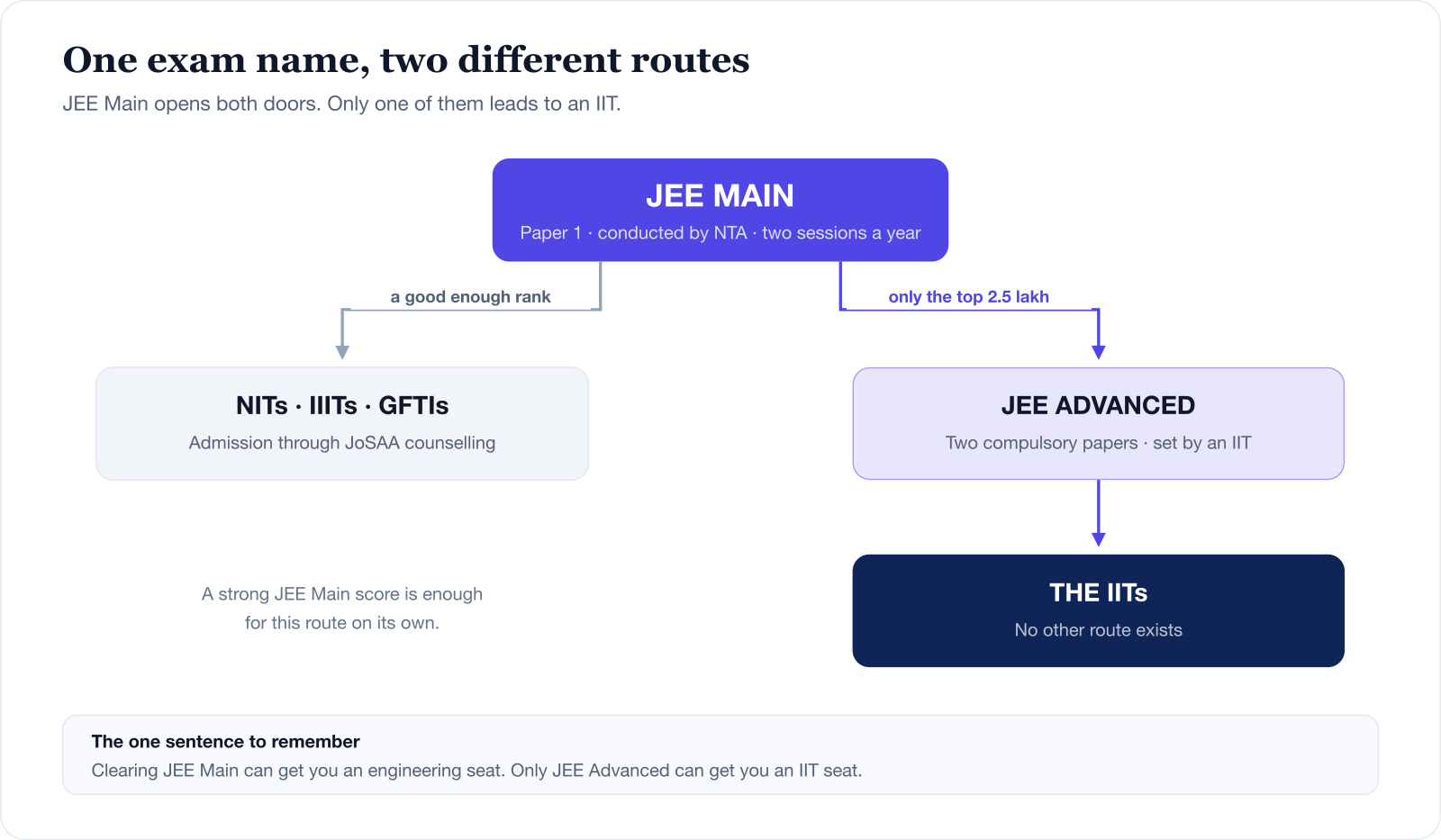
JEE Main is conducted by the NTA and does two jobs at once. For most candidates it is the exam that decides their engineering college outright — a good rank admits you to an NIT, an IIIT or another centrally funded institute through JoSAA counselling. For the students at the top of it, it is also a gate: only the top 2.5 lakh are permitted to register for the next exam.
JEE Advanced is conducted by one of the seven zonal IITs, on rotation, and it is the sole route into an IIT. There is no other door — no management quota, no separate entrance, nothing.
The one sentence worth remembering: clearing JEE Main can get you an engineering seat. Only JEE Advanced can get you an IIT seat.
| JEE Main | JEE Advanced | |
| Conducted by | National Testing Agency (NTA) | One of the seven zonal IITs, by rotation |
| Held | Twice a year, usually January and April | Once a year |
| Who may sit | Anyone who has passed or is appearing in Class 12 | Top 2.5 lakh of JEE Main Paper 1 only |
| Admits you to | NITs, IIITs and other centrally funded institutes | The IITs |
| Papers | One (Paper 1, for B.E./B.Tech) | Two, both compulsory |
2. JEE Main: how the paper is built
Paper 1 is the B.E./B.Tech paper, and it is the one that matters if an IIT is the goal. It is a computer-based test of three hours, with Physics, Chemistry and Mathematics carrying exactly equal weight.
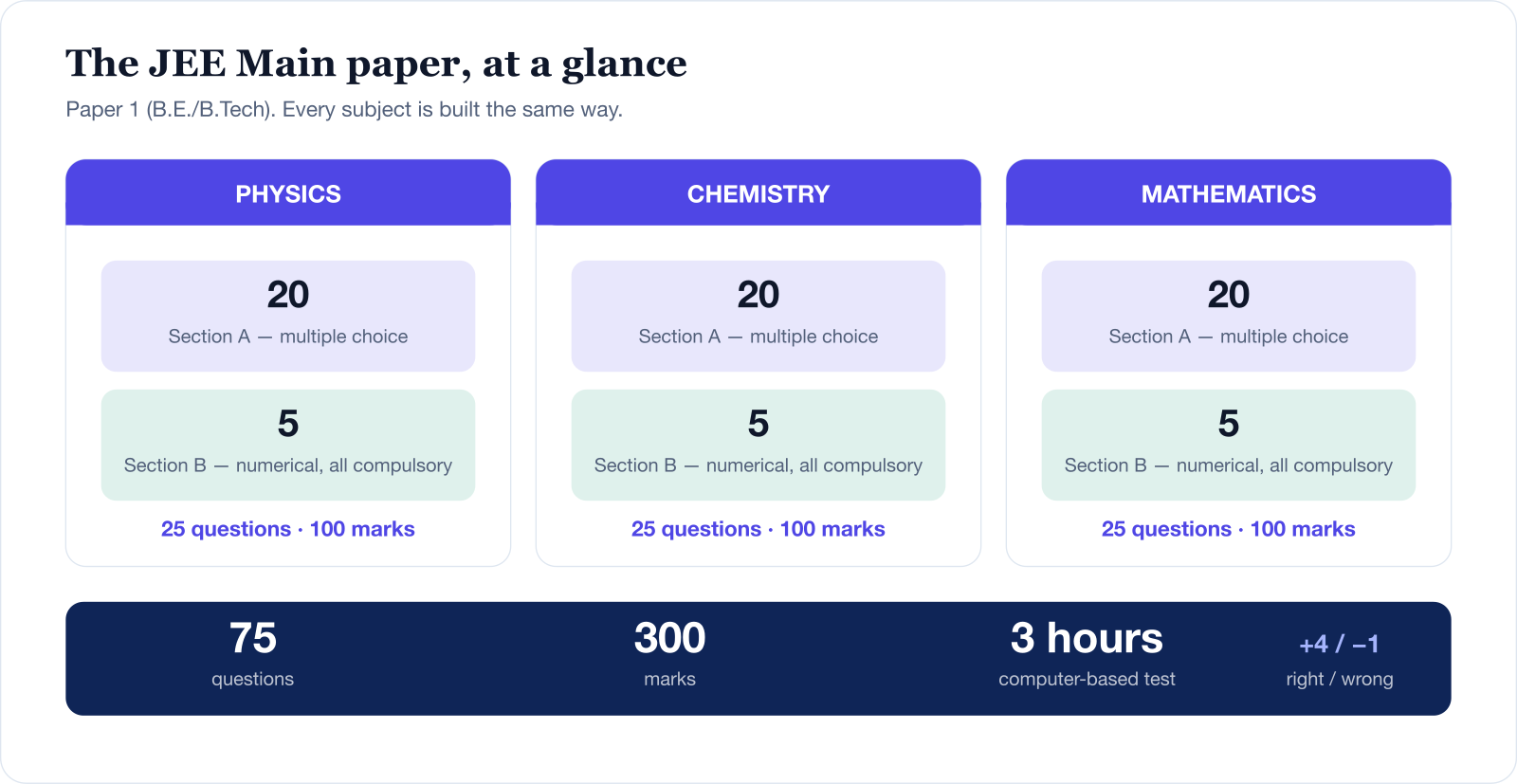
Every subject is built identically: twenty multiple-choice questions in Section A, and five numerical-answer questions in Section B. Section A gives you four options with one correct. Section B gives you no options at all — you type the value in, with nothing on screen to work backwards from.
The rule that changed, and still catches people out
Section B used to hold ten numerical questions of which you attempted any five. That optional choice has been removed — all five numerical questions are now compulsory.
This matters more than it sounds. Under the old rule, a student who had never properly studied one topic could route around it. Now the paper asks fifteen numerical questions across the three subjects and expects an answer to every one of them.
The marking scheme
| Outcome | Section A (MCQ) | Section B (numerical) |
| Correct answer | +4 | +4 |
| Wrong answer | −1 | −1 |
| Not attempted | 0 | 0 |
Two things are worth noticing about that table. The first is that a wrong answer does not cost one mark — it costs five, because you also gave up the four you would have had. The second is that negative marking on the numerical section is comparatively recent, and it is the rule most often quoted wrongly in preparation groups. Read the instructions screen before you begin your paper; this one has changed more than once.
Two sessions, and the percentile
JEE Main is held twice in an admission year. You may appear in both, and only your better result is counted — this is a genuine second attempt in the same year, not a consolation.
Your result is reported as a percentile, not as marks. A 99 percentile does not mean 99% of the marks; it means you scored better than 99% of the candidates who wrote that shift. Because different sessions and shifts are never exactly equal in difficulty, the NTA normalises across them — which is why the marks corresponding to a given percentile shift from year to year, and why comparing raw marks with a friend in a different shift tells you very little.
The other two papers
JEE Main is not only Paper 1. Paper 2A is for B.Arch and Paper 2B for B.Planning, and they are separate papers with their own structure — Mathematics and an aptitude test in both, plus a drawing test for B.Arch and planning-based questions for B.Planning. You can appear for more than one paper. If your target is engineering, Paper 1 is the only one you need.
3. JEE Advanced: how the paper is built
Where JEE Main rewards accuracy and speed on familiar shapes, JEE Advanced asks whether you actually understood the subject. Its reputation for being unpredictable is earned, and it is deliberate.
| Papers | Two — Paper 1 and Paper 2, both compulsory, on the same day |
| Duration | Three hours each |
| Subjects | Physics, Chemistry and Mathematics in both papers |
| Mode | Computer-based test |
| Pattern and marking | Deliberately not fixed — it changes from year to year |
That last row is the important one, and it is not a gap in this guide. The organising IIT changes the question types and the marking scheme most years, on purpose, so that the paper cannot be prepared for as a format. Any article claiming to give you next year’s exact JEE Advanced marking scheme is describing last year’s paper.
What is stable is the menu it draws from:
- Single correct MCQs — one right option among four, usually with negative marking.
- Multiple select questions — one or more options are correct, and full marks need all of them. Recent years have often allowed partial credit for a partly correct selection with nothing wrong ticked.
- Numerical answer type — type the value; no options.
- Paragraph-based and matching questions — several questions hanging off one passage or one column-matching grid, where an early misreading costs every mark in the block.
Because the marking scheme is part of the question paper in JEE Advanced, reading the instructions is not a formality — it is the first question. A student who assumes last year’s rules can lose marks they never needed to lose.
4. Who is allowed to sit
| Rule | JEE Main | JEE Advanced |
| Attempts | Three consecutive years. Both sessions of a year count as one attempt. | Two attempts, in consecutive years — and no more, ever. |
| Qualifying exam | Class 12 or equivalent | Class 12, plus a place in the top 2.5 lakh of JEE Main Paper 1 |
| Age | No age limit | A date-of-birth cutoff applies, with a five-year relaxation for SC, ST and PwD candidates |
| Board marks | Not required to appear | Not required to appear, but admission needs 75% in Class 12 (65% for SC, ST and PwD) or a place in the top 20 percentile of your board |
Two of those rules end campaigns quietly, and both are worth reading twice.
JEE Advanced gives you two attempts and they must be consecutive. Take a year off between them and the second one is simply gone. And the 75% board requirement is a genuine condition of admission rather than a formality — every year, students clear JEE Advanced with a usable rank and lose the seat on their Class 12 marks. The exact date-of-birth cutoff moves each year, so confirm it in that year’s information brochure rather than from a forum post.
5. The syllabus
Both stages draw on the same Class 11 and Class 12 material. The difference is not content, it is depth: JEE Main asks whether you can apply a standard result quickly and correctly, and JEE Advanced asks whether you can combine two ideas you were never shown together.
Physics
- Class 11 — mechanics (kinematics, laws of motion, work-energy-power, rotational motion), thermodynamics, properties of matter, waves and oscillations.
- Class 12 — electromagnetism (electrostatics, current electricity, magnetism), ray and wave optics, and modern physics.
Chemistry
- Physical — mole concept, atomic structure, thermodynamics, equilibrium, chemical kinetics, electrochemistry.
- Inorganic — periodic table, chemical bonding, coordination compounds, and the p-, d- and f-block elements.
- Organic — general organic chemistry, hydrocarbons, haloalkanes, alcohols, aldehydes and ketones, amines, biomolecules.
Mathematics
- Algebra — quadratic equations, complex numbers, sequences and series, matrices and determinants, permutations and combinations, probability.
- Calculus — limits, continuity and differentiability, applications of derivatives, integration, differential equations.
- Coordinate geometry — straight lines, circles, parabola, ellipse, hyperbola.
- Vectors and three-dimensional geometry.
- Trigonometry.
The syllabus is published by the NTA for JEE Main and by the organising IIT for JEE Advanced, and the two are close but not identical — a handful of topics appear in one and not the other in any given year. If you are working from a coaching module rather than the official document, check it against that year’s brochure before you decide a chapter is safe to skip.
6. What this all adds up to
Reduced to its essentials, the exam asks for three different things at three different points.
- JEE Main asks for accuracy under time. Seventy-five questions in three hours is about two and a half minutes each, and every wrong answer swings five marks against you.
- JEE Advanced asks for understanding. The format shifts each year precisely so that a student who has memorised question types cannot substitute that for knowing the subject.
- Both ask you to still be eligible when you get there. The attempt limits and the Class 12 requirement decide as many outcomes as the papers do, and they are the easiest part to get right.
Everything else — how to plan a year, which chapters carry the most marks, what a given percentile has historically meant, how to actually attempt a paper — is a separate conversation, and one we will take up in its own articles. This one is the map.
Quick answers
Frequently asked
What is the difference between JEE Main and JEE Advanced?
JEE Main is conducted by the NTA and admits you to NITs, IIITs and other centrally funded institutes. JEE Advanced is conducted by an IIT and is the only route into an IIT. You can only sit JEE Advanced if you are in the top 2.5 lakh of JEE Main Paper 1.
Can I get into an IIT through JEE Main alone?
No. JEE Advanced is the only route into an IIT. A strong JEE Main score gets you an NIT, IIIT or another centrally funded institute — and, if you are in the top 2.5 lakh, the right to sit JEE Advanced.
How many questions are there in JEE Main?
Seventy-five in Paper 1 — twenty-five in each of Physics, Chemistry and Mathematics, made up of 20 multiple-choice questions and 5 numerical questions per subject. The paper carries 300 marks and runs for three hours.
Do I still get to skip questions in Section B of JEE Main?
No. Section B used to offer ten numerical questions of which you attempted any five. That choice has been removed, and all five numerical questions in each subject are now compulsory.
Is there negative marking in JEE Main?
Yes — one mark is deducted for a wrong answer and four are awarded for a correct one, in both Section A and Section B. Unattempted questions score zero. The rule for the numerical section has changed more than once, so read the instructions screen before you begin your paper.
How many attempts do I get for JEE Main and JEE Advanced?
JEE Main allows three consecutive years, with both sessions of a year counting as one attempt. JEE Advanced allows only two attempts and they must be in consecutive years — skipping a year does not preserve the second one.
Do I need 75% in Class 12 to get into an IIT?
To be admitted, yes — 75% aggregate (65% for SC, ST and PwD candidates), or a place in the top 20 percentile of your board. You do not need it to appear for the exam, but it is a genuine condition of admission and students do lose seats to it every year.
Why does the JEE Advanced pattern change every year?
It is deliberate. The organising IIT rotates between the zonal IITs and changes question types and marking most years, so that the paper cannot be prepared for as a fixed format. This is why the marking scheme is printed in the paper itself and has to be read on the day.
Keep reading